Alexa Carlin (00:27):
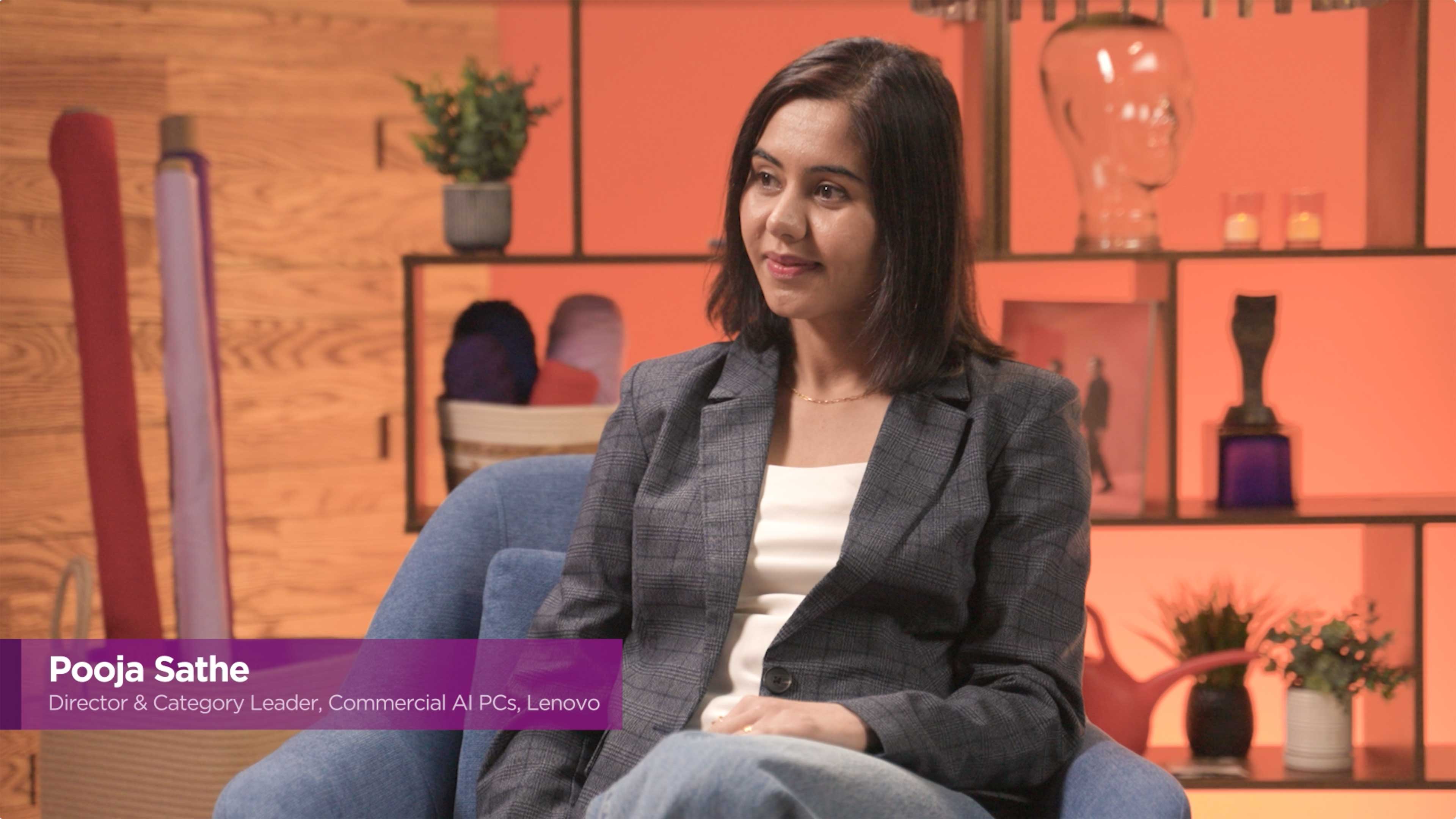
Hello and welcome to Accelerating Your AI journey. I'm your host, Alexa Carlin, and today we're talking about future-proofing technology for innovation by putting the right infrastructure in place to support the demands of AI across the organization. It seems every industry is feeling the pressure to adopt AI quickly, to keep pace with innovation and the competition. And building a sustainable strategy and a roadmap is so challenging. With me today is Pooja Sathe, Director and Category Leader, Commercial AI PCs at Lenovo. She's going to talk to us about the ins and outs of building a solid foundation that supports future advancements.
Welcome.
Pooja Sathe (01:17):
Thank you for having me on your show, Alexa.
Alexa Carlin (01:19):
Thanks for being here. So just tell us a little bit about yourself and what inspires you to work with companies who are eager to move the needle on innovation and technology.
Pooja Sathe (01:32):
Absolutely. So I have been with Lenovo for over a decade, and it's been a fantastic journey. I have worked in various different roles and finally settled into the role of building new categories, such as AI, PCs. And what inspires me to work with innovative companies is that journey of turning ideas into realities. And then there's a lot of learning. And what I love is the mindset of adopting the early technology versus waiting on the side lines.
Alexa Carlin (02:08):
Definitely seeing an idea turn into reality must be really energizing in your career.
Pooja Sathe (02:14):
It's absolutely exciting, yes.
Alexa Carlin (02:16):
So tell us what it means to future-proof an enterprise for AI.
Pooja Sathe (02:22):
So future-proofing simply means you're building and buying, not for now, but for what's next. And I want to start... I give you an example of your smartphone. So tell me, Alexa, how many apps do you have on your phone? And I'm putting you on spot here.
Alexa Carlin (02:45):
I would say, I don't know, maybe 30, 40.
Pooja Sathe (02:50):
You have fewer apps than what I have.
Alexa Carlin (02:52):
Well, how many-
Pooja Sathe (02:55):
I was looking at it. Almost a hundred apps.
Alexa Carlin (02:58):
A hundred apps?
Pooja Sathe (03:00):
Yeah.
Alexa Carlin (03:00):
You need to go and clean that out after this.
Pooja Sathe (03:03):
I use the majority of them, honestly.
Alexa Carlin (03:05):
Oh really? Wow.
Pooja Sathe (03:05):
Not on a regular basis, but I know I may need it. So the reason I bring this up is, the union of Cloud technology and smartphone really led to all these applications. And it fundamentally changed the way we are consuming the content or we are managing our health or travel or calendar. And similarly on the PCs, PCs are getting more and more computing power, so better graphic cards, better CPU. And then you have a new compute engine called NPU, Neural Processing Unit. So AMD Ryzen, the Strix Point, has 50 TOPS NPU, 50 trillion operations per second, and that at a much lower power and really power efficient. So imagine the compute power that you have on a PC now.
(04:13):
And you have the emergence of AI. There are a lot of AI models coming. In fact, you would see that there would be, hacking phase had more than 1 million models at this point, open source models. Then there are some models, small language models, that can run on the PC. So an enterprise has pretty much two options at this point. They can either run existing workloads efficiently and faster because of all this compute power that we've got, or they can completely change the game and bring new workloads on the PC. So it's an option. So future-proofing is the right choice.
Alexa Carlin (05:02):
To make sure that what they're investing in now is going to serve them in the future.
Pooja Sathe (05:06):
Absolutely.
Alexa Carlin (05:07):
So what are you hearing from your customers when you talk to them about future-proofing? What are some of their big questions?
Pooja Sathe (05:15):
Most of the times what we hear is ROI. What is my return on investment? And I'm investing in the AI PCs because they're more expensive than the traditional PCs. So that's the question we get asked. But I would say why ROI is important. I think it's important to understand what are the use cases and experiences. So you have to start with that, versus starting with ROI.
Alexa Carlin (05:46):
So do you have an example that you could share?
Pooja Sathe (05:48):
Yeah, absolutely. So most of the companies, they have AI priorities, whether they are investing in improving customer experience or they are investing in driving new products and services, or it's really simply boosting your employee productivity. And most of these workloads right now are running on the Cloud, but guess what? You can bring it on the device. And there are many models, especially the smaller language models, whether it's Llama 3 or the DeepSeq 7 billion parameter model, it can run on the AI PCs powered by AMD Ryzen. And that's the beauty that you can bring it on the device.
Alexa Carlin (06:35):
Can you share why an enterprise would want to bring it on the device versus run on the Cloud?
Pooja Sathe (06:42):
Absolutely. So two big reasons. Tokens on the Cloud are expensive, so it's going to be expensive. It's all about if you're running multiple workloads, how much do you want to invest in Cloud? So you have to figure out a way where you can bring some workloads on the device, on the PC. The other reason is security and privacy.
Alexa Carlin (07:09):
That's a big one.
Pooja Sathe (07:10):
That's a big one. And especially for enterprises, there are some highly regulated industries where you do not want your data to go on the Cloud. So those are the two reasons why you would say, I want to run these workloads on these AI PCs. So it's a no-brainer.
Alexa Carlin (07:31):
Sounds like it. So everyone's trying to move quickly to keep pace with innovation and the competition. What can they do in the near term to stay on track?
Pooja Sathe (07:44):
I would say start with pilots, and not just one, but pilots across multiple areas. As I said before, it can be really around customer experience. It can be around how do I augment my current workforce to do better? How can I help them delegate some of the routine, repetitive tasks? Or it can be really investing in your products or services. So you have to start with some pilots because it's going to help you learn and then you can iterate to do better.
Alexa Carlin (08:24):
And how would they even know how to run a pilot or where to start?
Pooja Sathe (08:28):
Lenovo can help here, and this is where we have services like AI PC Fast Start, where we can provide discovery workshops for you and help you identify areas where you can invest in. And then we can also help you identify the right devices that we have. So we have, as I mentioned, we have AI PCs powered by AMD that can run a lot of different AI workloads thanks to the NPU that we have.
Alexa Carlin (09:03):
I feel like that's the big thing. People are just overwhelmed, so it's great to have a partner that helps take that off the plate.
Pooja Sathe (09:11):
Absolutely.
Alexa Carlin (09:12):
So what are your customers doing with it, the next generation of devices?
Pooja Sathe (09:18):
Every customer is at a different point in their journey, Alexa. But what is a very practical way to implement AI is driving purpose-built AI agents. And when I say purpose-built AI agents, take an example of AI agent for software development. So you can write and review your codes faster than if you're writing it yourself. So agent can help you. The one which I found interesting was agent for sales assistant. Let's take an example of Lenovo. We have a diverse portfolio of products and services. Having product information at your fingertips for the seller is hard. So you can use the agent to really understand the product, pricing, features, and be better at your job.
Alexa Carlin (10:21):
So you don't have to memorize all that.
Pooja Sathe (10:23):
You don't have to memorize, yeah. AI is there to memorize for you. You do the selling.
Alexa Carlin (10:29):
And the relationships.
Pooja Sathe (10:30):
And the relationships, and that's important. And that's important for anyone, actually.
Alexa Carlin (10:33):
Yeah, definitely. So this has been an amazing conversation. I do have one final question. What does smarter AI for all mean to you?
Pooja Sathe (10:42):
What I feel is, Lenovo is well-positioned to deliver AI solutions across industries and across different customer segments. And I say that because AI needs two things. It needs data and it needs computing power. And we have a very diverse portfolio from phones to PCs, tablets, workstations, infrastructure solutions, that can really help with the computing power that you need and ability to manage and work with your data.
Alexa Carlin (11:25):
Making it smarter.
Pooja Sathe (11:26):
Making it smarter.
Alexa Carlin (11:28):
Well, thank you so much. This has been a great conversation.
Pooja Sathe (11:31):
Absolutely. My pleasure. Thank you, Alexa.
Alexa Carlin (11:34):
I'd like to thank my guest, Pooja Sathe, Director and Category Leader, Commercial AI PCs at Lenovo for stopping by and talking with us today. And thank you for watching. Remember to visit us online to learn more about how Lenovo can help you accelerate your AI journey on the road to smarter AI for all.