
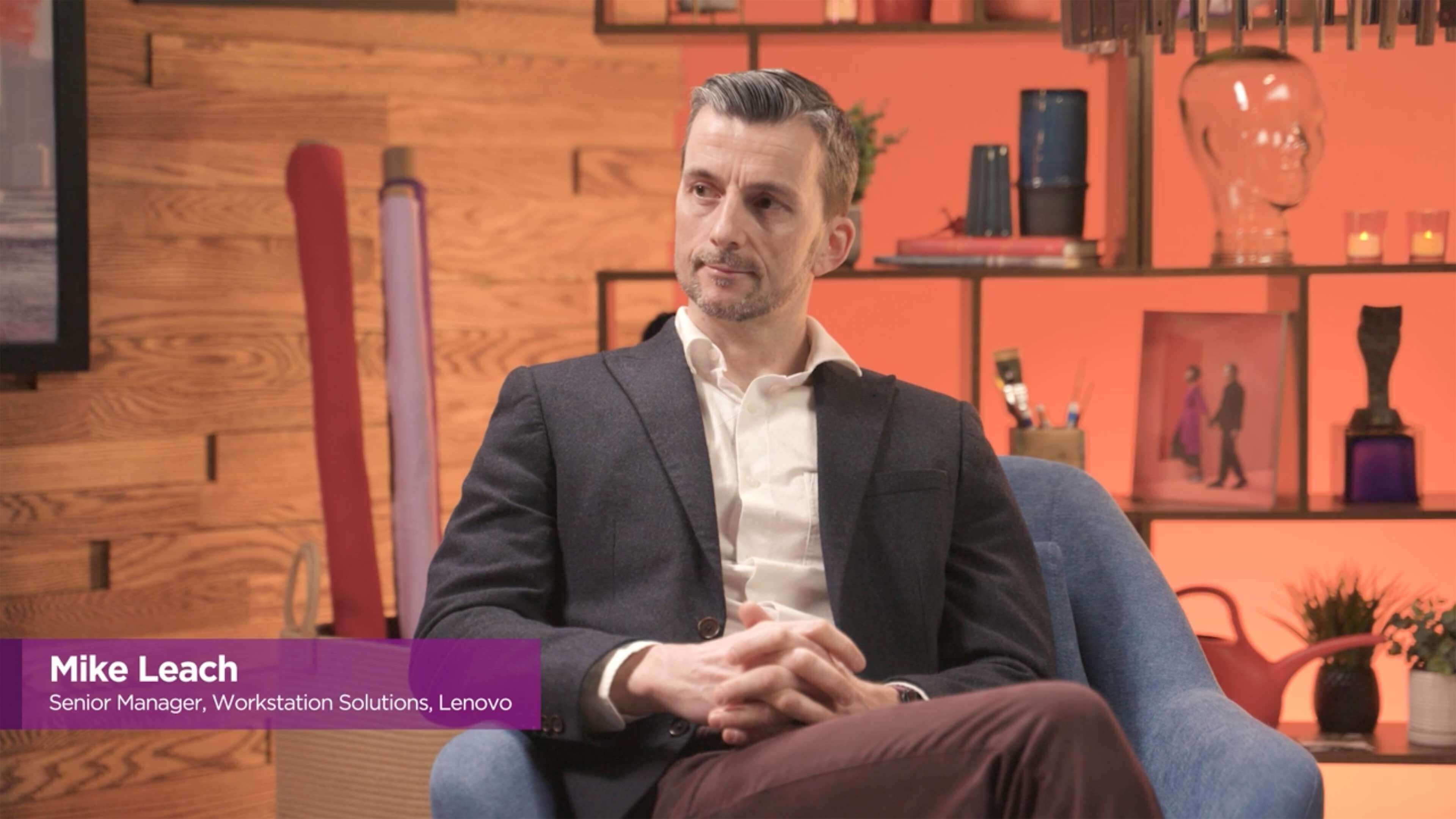
View Transcript
Alexa Carlin (00:27): Hello and welcome to Accelerating Your AI journey. I'm your host, Alexa Carlin, and today we're talking about AI, creativity and innovation. I have Mike Leach, Senior Manager - Workstation Solutions at Lenovo, here with me to help us think beyond traditional boundaries, solve complex challenges, and maintain a competitive edge with AI. Welcome Mike.
Mike Leach (00:54): Hi Alexa.
Alexa Carlin (00:54): So tell us about yourself and what inspires you to work with innovative, technologically driven companies.
Mike Leach (01:01): Well, I've been in the IT industry for far too many years. I won't embarrass myself with the age. But for me, I love working with innovation, the bleeding edge of technology. For me, artificial intelligence brings in this new bleeding edge, but it's the first time technology has been able to touch so many different people in such a positive way. I'm passionate about technology, and for me, I think artificial intelligence is that next fuel.
Alexa Carlin (01:25): What a great way to set us up to talk about creativity and innovation. Let's start us off by talking about how AI is redefining creativity and innovation in organization, and what it unlocks for businesses to gain a competitive edge. So what are some really practical and really game changing examples that you're seeing right now?
Mike Leach (01:49): I mean, creativity is a great one. But if we boil every use case back, it needs to be personalized, it needs to be productive, it needs to be protected. So on device AI is what's empowering this next level. If I'm a creative artist, if I'm a media, I'm giving you a superpower. So AI now, it's not this unknown, it's a workflow superpower. It can make you faster. No one wants to start an idea off on a blank sheet of paper.
Alexa Carlin (02:16): Oh yeah, that's the hardest.
Mike Leach (02:18): And you can stare at that blank sheet of paper all day long. But if you can be given 15 quick start guides or 15 examples of different ways you can do things, it makes you faster, it makes you more competitive. And productivity is that area where you can guarantee to save money.
(02:34): So AI shouldn't be seen as a risk. The risk is not embracing it. But it fuels creativity. It's therefore innovative for your company and for me, giving every employee the ability to be Superman or Superwoman, you move away from those mundane tasks and you can concentrate on fueling creativity for you, or innovation, whatever your workflow is, where that's needed to be. So your upper 10% is now where you spend 90% of your time.
Alexa Carlin (03:05): So you can focus more on things that really need that human element and delegate all the mundane, but also use AI as a brainstorming partner, as an assistant.
Mike Leach (03:18): Yeah, I treat you like in the kitchen. Everyone likes to go to that delicatessen and pick the posh pastries and things you see on the front shelf. No one really cares about, well, what does the kitchen look like behind? And for me, you walk into any top end chef's kitchen and it's an absolute mess. It's carnage, but the iterations that happen in that kitchen are kind of like, well, you don't appreciate how much there is under the waterline, like an iceberg. So much of it's under the waterline.
(03:44): So what we're trying to do is almost embrace some of those. So you aren't spending too much time in the kitchen. You can spend more time outside,, glossing and dressing those pastries versus the hard work that typically happens in the kitchen that can go away, that can be automated. That's where you fuel productivity and efficiency, and then you can spend your time where you get the best outcome.
Alexa Carlin (04:05): Definitely. So is there one example that you've seen that's just like, wow, I cannot believe that this was created with AI?
Mike Leach (04:13): Yes, very much so. We work a lot with Lenovo Workstations in computer graphics, and the world of CGI, you know, has evolved massively now. And we were working with an architectural company in London just last summer, and they normally go through a design iteration process that takes anything between nine and 12 months. So large projects, things building of the next airport in Dubai, something of that magnitude. And they used AI to take a design process down from nine months to like nine hours, where AI gave them not just one idea, but hundreds of ideas they could propose in front of the customer.
(04:50): And they went from zero to a hundred miles an hour instantly, and it allowed them then to concentrate on certain areas. And then they used generative design and AI itself then gave them more efficient ways of producing equipment, producing materials lighter, cheaper, faster. And it was their superpower, their strengths was in their structural design capabilities. And AI was the tool that allowed them to run at a thousand miles an hour where everyone can traditionally only run at maybe 10 miles an hour.
Alexa Carlin (05:23): So now you could do so much more with a very small, tight-knit group of people, where they can focus on not so much, oh, now AI can take over this and we have less to do, but now let's focus on things that can really move the needle forward.
Mike Leach (05:41): It automated the mundane, the bits of the task that everyone has to do. How do you go price a project? Well, it takes me weeks and weeks. I have to go back through all the paperwork from maybe the last project. Well, AI does all that for you. It's your personal admin. It runs into every rabbit hole. It digs out the information.
(05:58): And again, it's that superpower. It enables you to be a lot more effective, a lot more efficient. You focus your time, time is money, you can focus your time on what actually will have impact on the business. So it's taking what, the last 20% of a project is where it takes 80% of the time, and you can now spend 90, a hundred percent of the time on that, and really fine tune the outcome. Whether that's, am I an artist? Am I creating drawings, am I film? Am I editing documents? Whatever your skill set is, you can now spend more time on making that unique to you or more effective for your business. So...
Alexa Carlin (06:36): Yeah, I do a lot of public speaking, and sometimes I get so much writer's block when I want to add a new story to my keynote, and I used Gen AI to say, hey, this is the story I want to add. Help me figure out a transition from this lesson to this lesson. And it just helped that workflow go so much faster so I can focus on the presentation itself.
Mike Leach (07:00): Yeah. And we've seen that thousands of times over, I mean, platforms like AMD Ryzen processors now can enable your average client device, your average ThinkPad type from Lenovo, where you can have those tools on device, they're protected, they're personal. So maybe you're asking unique company IP related questions, something you can't go and host in the cloud, something you want to run on the device. So you can have an on-device, what we call like a personal knowledge base, and you can ask questions based on that.
(07:30): So your example with the presentation, well maybe three months from now you want to go back and look at, how did I transition from X to Y? Well, you can go do that because it's AI on your device.
Alexa Carlin (07:42): And it's learning from that to make it even better and better.
Mike Leach (07:44): It's unique to you because the way that your answer something, the way that I'll answer something are completely different. And what we've seen is that's now where, well, it's a superpower, but you don't want to give it away and it will grow over time. So your AI might start, it is trained on nothing today, so it's not that intelligent, but over time... It's like looking at your smartphone, it knows more and more about you, the more you use it, and it's having that to empower your business so you just get stronger and stronger and stronger using the power of things like artificial-
Alexa Carlin (08:13): You just solved a problem that I was seeing with AI, but now it's on the Lenovo device, you're saying.
Mike Leach (08:19): We're empowering that on the device as a personal knowledge base. Tools like Lenovo's AI now is that platform where it can learn what you do. You might ingest certain documents, and we use AMD Ryzen processors to empower that to make it faster and quicker. Because the more you can do things, the less lag in your workflow, makes you more productive and a more effective employee.
(08:44): I think businesses don't appreciate that AI doesn't come for free. It has to be paid for somehow either in software licensing or in additional tools, but what it will enable your employee to do, it's less trips to the coffee machine, less cigarette breaks or time [inaudible 00:09:00]. They can be super efficient and that's where time is money and ultimately it makes a lot more effective.
Alexa Carlin (09:05): And you can see the ROI.
Mike Leach (09:07): Yeah, big time. I mean ROI this year is kind of, AI is the year of, show me not just tell me, for 2025. And I think now there's any workflow, you put a clock timer on someone's desk and every time they stopped to have to manually do something and go back, like a chess clock, and you'll see that the 30, 60, 90 minutes a day they'll claim back the hundreds of hours a year for the slight uptick in a device cost or a software license. Cheap can be expensive, and you look at it through an operational cost, it's a no-brainer.
Alexa Carlin (09:38): Yeah. So we talked a lot about the benefits, but integrating AI into creative and design workflows has a lot of challenges. So what are some of those common issues that you're seeing, and what can be done to overcome them?
Mike Leach (09:53): Yeah, I mean there's known issues with AI. It has to be done responsibly, ethically, some of the response, you don't want biased outcomes. So AI is not, it's a journey, it's not a destination. So it's constantly learning, it's constantly tweaking. AI models need to be fine-tuned. And what we have seen now is some of those challenges with businesses are like, well, I tried AI 12 months ago and it wasn't great. Well, it's constantly evolving.
Alexa Carlin (10:19): And it's evolving quickly.
Mike Leach (10:21): At an alarming rate. I mean, we have an example from a Lenovo workstation business standpoint, but if I mentioned ChatGPT, everyone knows ChatGPT. It is powered by an open AI model for every one open AI model, there's over 1.4 million open source alternatives that you can use for free.
(10:42): And those models are all built different ways and sizes. They're optimized in different ways because they're built for very domain specific tasks. So what we've seen is the issue companies have kind of seen, is AI is this behemoth of how do I go and navigate that? Well, AI is broken down now into smaller chunks. So what we see now is an agentic AI where we have smaller bits of AI that all talk to each other.
(11:10): And that's the challenge that we can overcome now is well look, you have to secure that. So things like Think Shield allow you to start and secure a lot more of your AI on device.
Alexa Carlin (11:19): So you're saying someone's customer service rep that's an AI can talk to another business's customer service rep that's also an AI.
Mike Leach (11:28): So we can automate some of the standard tasks. Typically, there's prompt AI, so you type in a question, it spits you out the answer. But if you want the outcome of, me switching a light on turns the TV on, you have your smart home. You can have these kinds of automated processes that if this, then that. So you can have these agents now all talking to each other.
(11:49): So if a customer service rep, if you press two or your answer included word, it flags this and then it brings up the next agent. So you have all these smaller AIs, but they're all interconnected with each other. So your device now becomes a little bit more of a powerhouse. So AMD Ryzen processors allow you now to start having a lot more of these smaller AI experiences on the device, and they can all interwork together. So the future is, is this agentic workflow and then bringing that into a hybrid infrastructure where you'll have AI on device, AI in the cloud, AI on-prem, and the way the nerves sort of uniquely fit is that we can help solve a lot of those challenges. It's a destination for customers. It's actually a journey.
(12:34): So we can help you on that journey. Any journey you go on five minutes or five days, it's a road trip. We can help you on that journey. We can help onboard you, we can help you along the way. We can provide the best soundtrack, we give you the best nav instructions so you don't get lost. Just think of it like a large journey. Customers want assistance and we can be very much that technology partner to help.
Alexa Carlin (12:54): Yeah, sounds like a fun road trip.
Mike Leach (12:56): I'm looking forward to it. Definitely.
Alexa Carlin (12:58): So we've talked a lot about AI and technology as it relates to productivity and innovation. How can business leaders foster a culture of innovation and out-of-the-box thinking across their teams, so that their tech investments are used to their greatest capacity?
Mike Leach (13:14): You can look at it for tech investments, AI, it's one of the largest computational challenges of our time. We can't shy away from the fact that with great power becomes great responsibility. And AI is very powerful, but it needs lots of compute power to go do that.
(13:32): So as a customer, if you're looking to invest in devices today, knowing how fast AI is churning and how quickly it's iterating, you have to factor in this future-proofing element. So no one wants to replace a laptop every year. They might have a three or a five-year refresh cycle. Is to making sure that you've got enough headroom in that device to now support not just next-generation AI, but next-to-next-generation AI.
(13:58): Because the velocity of what we're seeing of change ChatGPT from three years ago versus today is vastly different. And it's the same with agentic AI. We're going to see more of this flow. So for me, making sure that you invest in not just the right device, but the right configuration of device for the right people at the right time.
(14:20): Platforms like a AMD Ryzen processors give you that future-proofing, that headroom, the computational architecture excellence that comes in that silicon is built to not just power compute today, but the compute workflow of the future.
Alexa Carlin (14:34): Yeah, that's definitely important. Because nobody wants to invest all this time and money and resources, and then two years from now, it's, technology changed completely and you can't even do anything with it.
Mike Leach (14:46): Well, AI is not hardware, AI is software and together. And if it's not a 50-50 mix, depending on what the task, every workflow, every AI use case has a different need of software or hardware. If you don't have that, I say magic ingredient, if you have the right ingredients. I'm no chef, but if we went backstage now into the kitchen, had to bake off same ingredients, we both come out with completely different cakes. So it's not just about having the right ingredients, it's bringing those together and being able to use them in the right way so you get the same and a repeatable outcome.
Alexa Carlin (15:23): And customized to what you want.
Mike Leach (15:25): Yeah, definitely. Yes. Yeah.
Alexa Carlin (15:26): Well, this has been a very insightful conversation. I do have one final question. What does smarter AI for all mean to you?
Mike Leach (15:35): Well, smarter AI for all. I mean, for me, AI is a superpower. So by fueling productivity, fueling efficiency, smarter AI for all is that superpower for everybody. All employees, all pay grades, all levels, and it's about fueling those best business outcomes for organizations.
Alexa Carlin (15:53): Well, that's been very eye-opening. I feel like I could talk to you for hours about this topic. So thank you so much again for being here.
Mike Leach (16:01): Been wonderful. Thanks for having me.
Alexa Carlin (16:03): I'd like to thank my guest, Mike Leach, Senior Manager - Workstation Solutions at Lenovo for stopping by and talking with us today. And thank you for watching. Visit us online to learn more about how Lenovo can help you accelerate your AI journey, on the road to smarter AI for all.
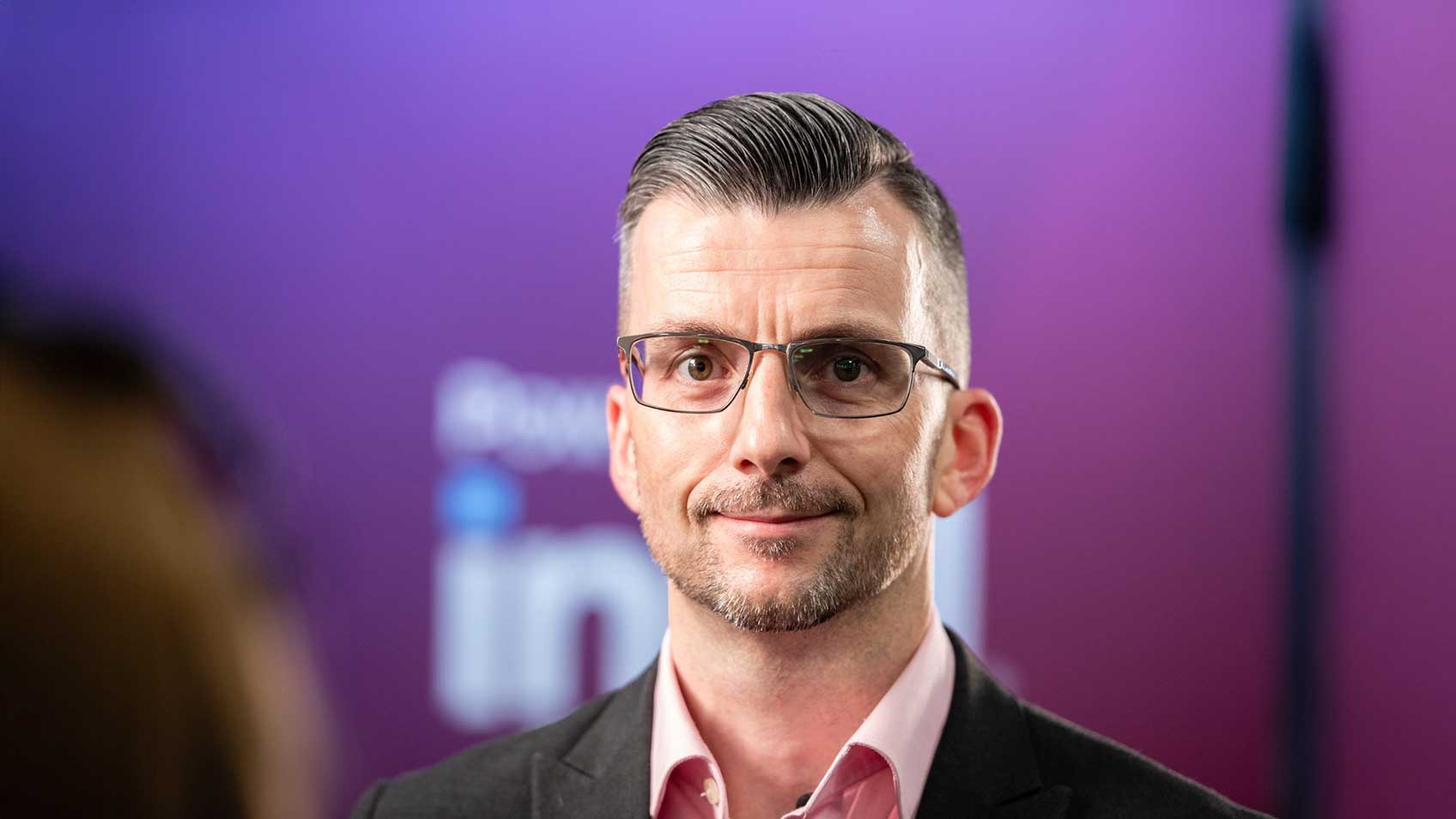
Mike Leach
Senior Manager, Workstation Solutions, Lenovo
Mike is a graphics workstation and technology evangelist with over 20 years’ experience; having seen the rise and fall of every major workstation technology trend since the late ‘90s. Mike currently manages the worldwide solution portfolio team for Lenovo Workstations, specializing in Client AI/Data Science, Spatial Computing, and Remote/Cloud Workstation Solutions. He is a proud father, technology geek, motorsport fan, and fitness fanatic.
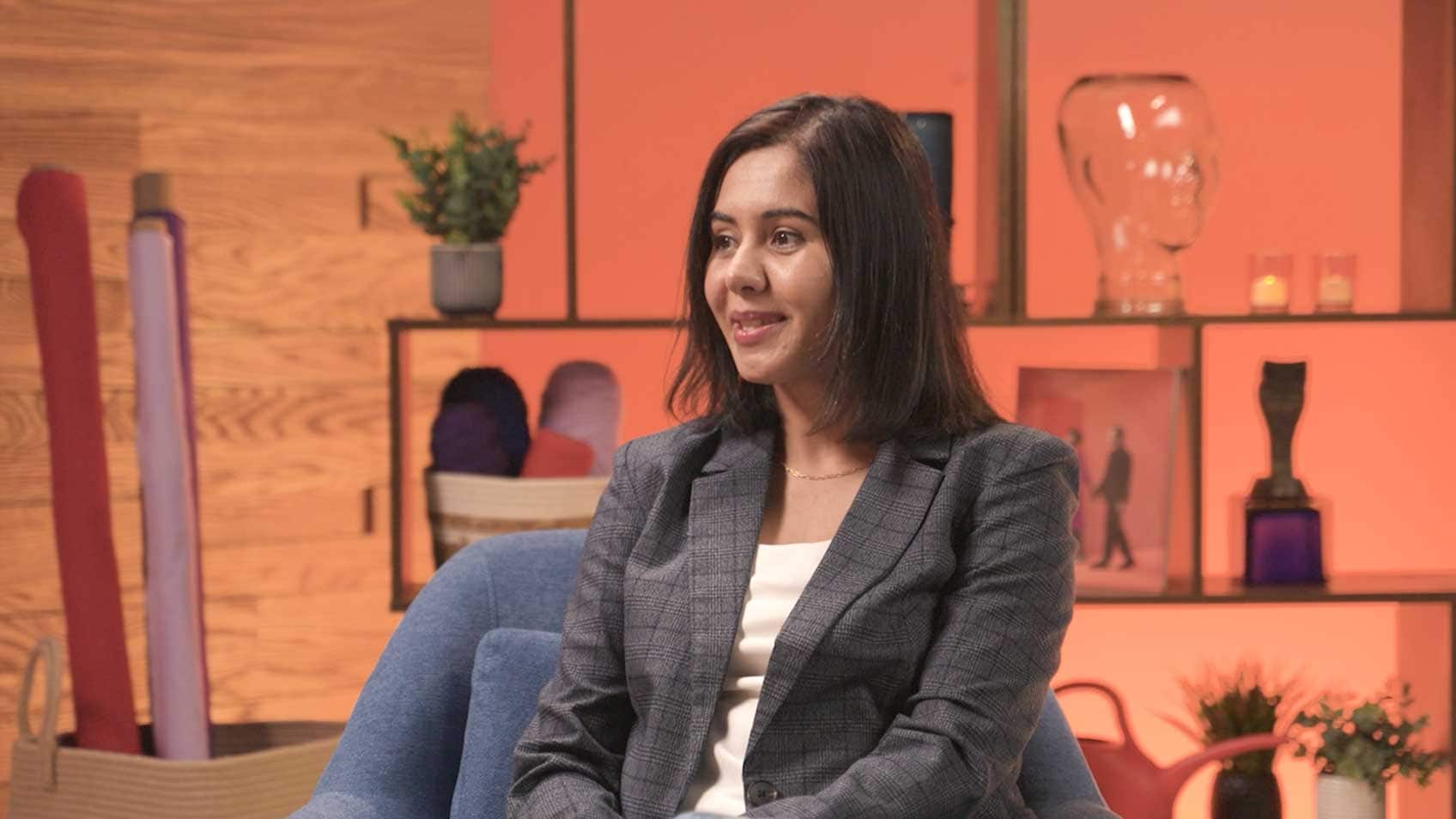
Future-Proofing Your Enterprise for AI
Pooja Sathe, Director & Category Leader, Commercial AI PCs, Lenovo

AI in Risk Management
Nima Baiati, Executive Director & General Manager, Cybersecurity Solutions & Head of Cybersecurity Innovation Centre, Lenovo
Windows 11 Migration
Provide more powerful experiences and consistency with better security for all.
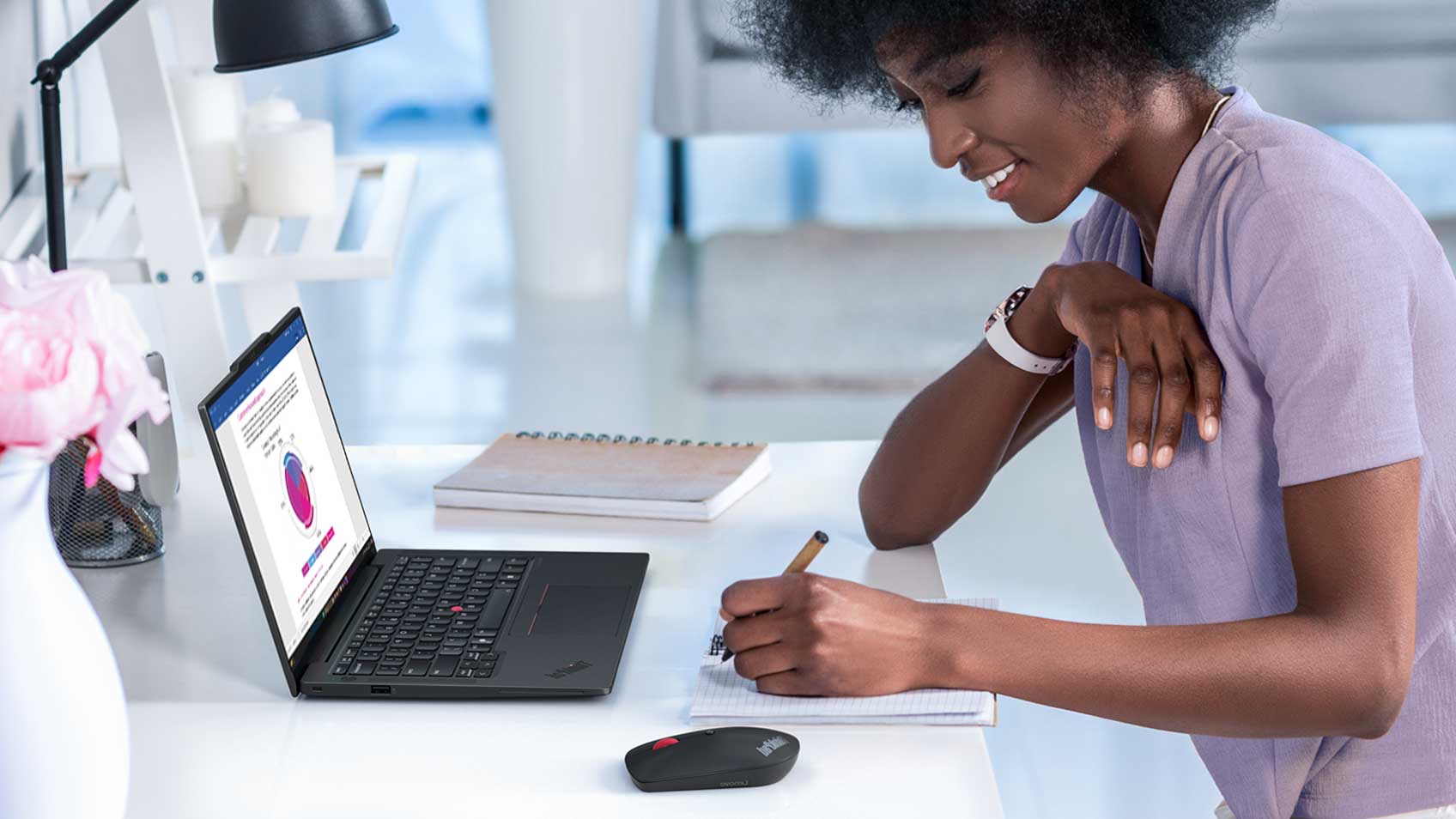
AI PC With AMD
Streamline and enhance everyday tasks with smarter AI that’s personalized for each user.

AI PCs With Intel®
Dive into how AI PCs provide more personalized, productive, and protected experiences.

Empower Employee Experiences With AI
Learn how to empower your teams to do more with AI-powered tools and Lenovo’s Digital Workplace Solutions.

Navigating Sustainability in the AI Era
Find out how you can leverage AI and still meet your sustainability goals.

Lenovo AI Services & TruScale
Get help expediting and scaling your AI transformation.

Hybrid AI With AMD
Learn how to drive innovation, efficiency, and real-world impact with high-performance computing.
Hybrid AI With NVIDIA
Accelerate your AI journey and drive ROI with hybrid AI, data orchestration for all, and agentic AI.
Contact Us
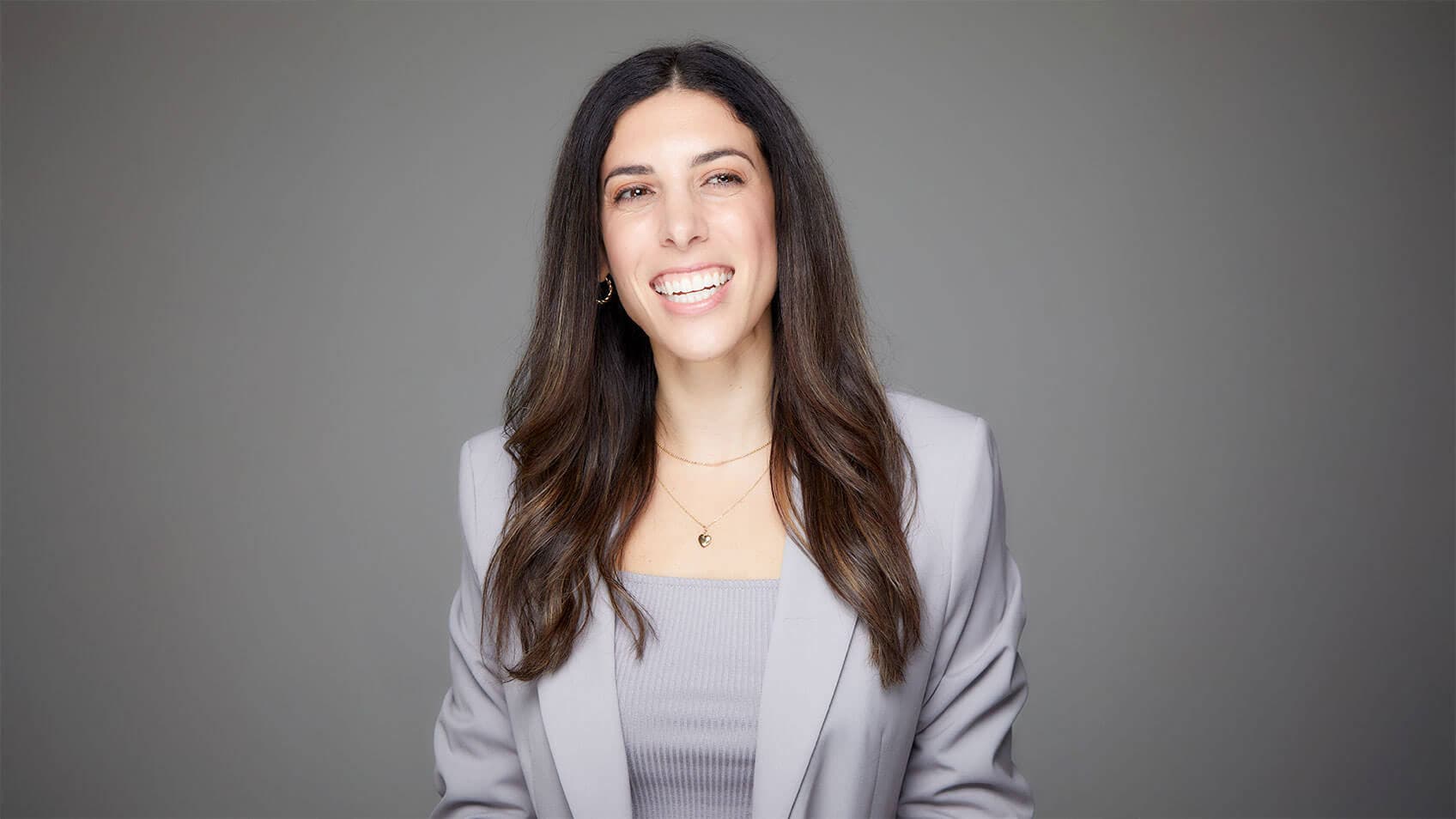
Meet Your Host,
Alexa Carlin
Alexa Carlin is an in-demand public speaker, bestselling author, top content creator for women's empowerment, and the Founder of Women Empower X. Alexa has worked with Fortune Global 500 brands to create captivating and relatable content. She has been featured on the Oprah Winfrey Network, Cheddar TV, FOX, ABC, CBS, TEDx and in Entrepreneur, Glamour Magazine, and Forbes, among others.

