
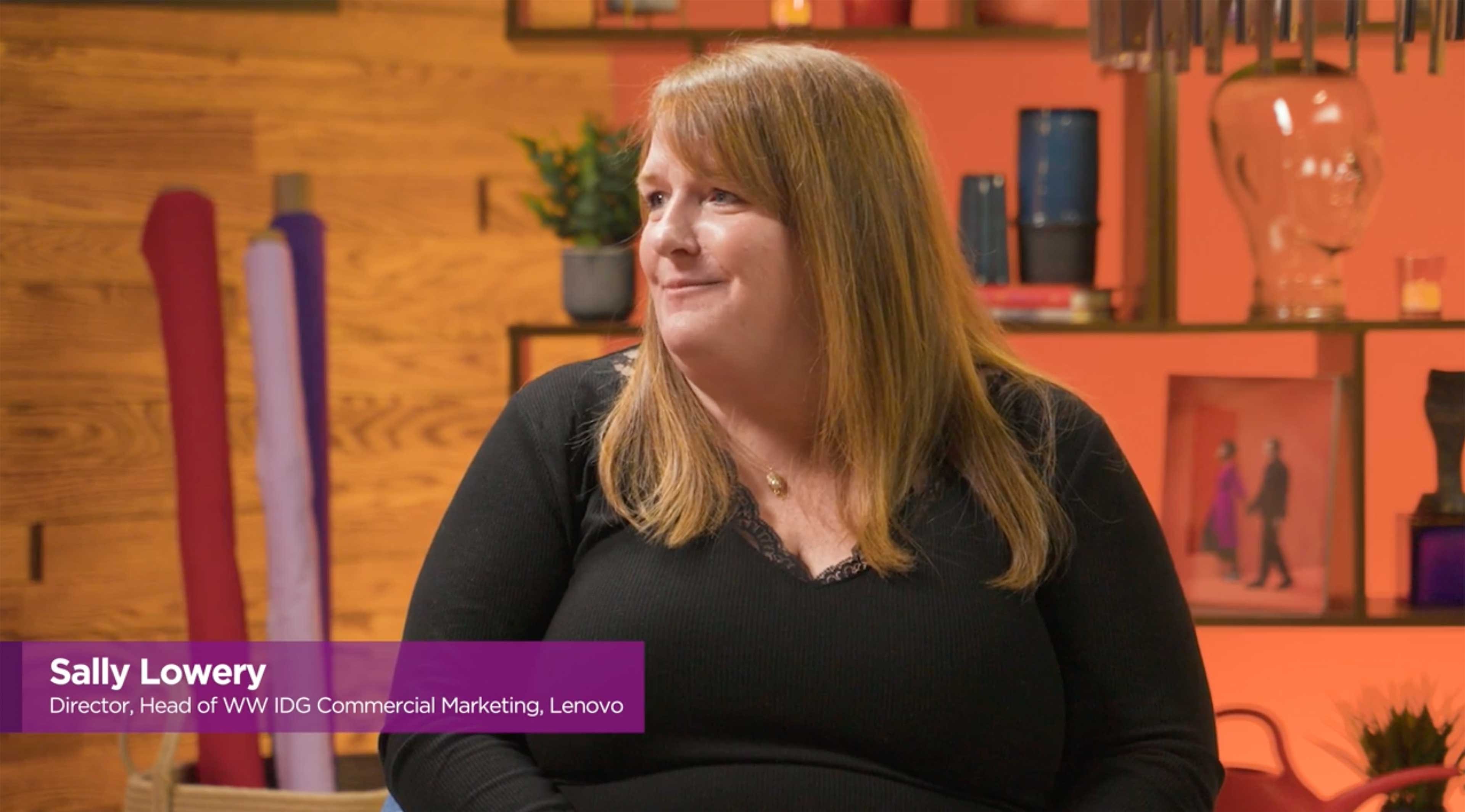
View Transcript
Alexa Carlin (00:27): Hello and welcome to Accelerating Your AI Journey. I'm your host, Alexa Carlin, and today we're talking about the hitting costs of postponing the migration to Windows 11. I have Sally Lowery, director head of Worldwide IDG Commercial Marketing at Lenovo, here with me to help us understand how to avoid these pitfalls and maintain a competitive advantage. Welcome, Sally.
Sally Lowery (00:54): Thanks for having me.
Alexa Carlin (00:55): Yeah, thanks for being here. So, tell us a little bit about yourself and what inspires you to work with innovative, technologically-driven companies.
Sally Lowery (01:03): I have worked in technology my entire career. I love the idea of innovation, right. And invention can look like a lot of different things in a lot of different ways.
(01:13): I think, most recently, Windows 11 is one of those inventions that I think is coming to life where it's really driven around how do we create more productivity, better collaboration, even just automating things like security vulnerabilities, reducing the time we spend on things to be more efficient so we can spend time on inventing more.
(01:39): And I just love the idea of always trying to find opportunities to be smarter. Work smarter, not harder. And I think that this is one of those opportunities with Windows 11.
Alexa Carlin (01:50): Yeah, definitely to delegate all those mundane tasks-
Sally Lowery (01:52): Yes.
Alexa Carlin (01:52): ... so we can focus on the fun things.
Sally Lowery (01:54): Absolutely.
Alexa Carlin (01:56): So, the end-of-service date for Windows 10 is really creeping up on us. October 14th is only a few months out. In a recent poll, we learned that one of the main reasons many organizations are delaying their migration to Windows 11 is budget constraints.
Sally Lowery (02:14): Yes.
Alexa Carlin (02:14): They're concerned about the cost to migrate, but they're also at risk of incurring other hidden costs and potentially equal costs if they wait. So, what financial and operational risks should businesses anticipate if they delay upgrading from Windows 10 beyond the end-of-service date?
Sally Lowery (02:34): I mean, I think the reality is there's realized operational cost to not migrate. The reality is you're going to have to increase support because it will no longer be a supported solution. In addition to that, you are going to have software upgrade challenges. So it's not going to be just that you didn't upgrade Windows 11. It's going to be that you have other services that also require upgrades to be more compatible. But I think there's also a pretty significant opportunity cost.
(03:08): And I think that opportunity cost comes at, are you being competitive? If you think about, for example, there's compression on device purchases, and there's compression on software upgrades in terms of budget, but do you know where the budget sits? AI. Organizations are being asked to really be able to invest in AI. Windows 11 actually unlocks for their end users a ton of AI capabilities out of the box. And so I think by not migrating, you're actually preventing your organization from being competitive.
(03:44): You're risking really being behind your competition, but you're also risking the ability to get a little bit faster, smarter with the way that you do business. And I think that that's something that certainly also needs to be considered. And it also might give them room to think about how do I make this not only a Windows 11 refresh discussion but an AI PC discussion? How do I put more AI power?
(04:11): So, thinking about like AMD Ryzen and how does it work in terms of being a compelling opportunity to do some pretty aggressive AI capabilities for their end users. I think it's an opportunity to look at that. And then, finally, the other thing I would say is there's security risks. So we just have to be mindful that by doing that that comes with real cost, maintenance, security vulnerabilities, and compliance vulnerabilities as well. And so I think all of those should be assessed as you're thinking through where to spend your budget.
Alexa Carlin (04:43): Definitely. I mean, a lot of times we look at just the hard costs of right now-
Sally Lowery (04:48): [inaudible 00:04:48].
Alexa Carlin (04:47): ... but I love that you brought up opportunity costs because that could be massive in the future.
Sally Lowery (04:52): Absolutely. Absolutely.
Alexa Carlin (04:53): So how can adoption of Windows 11 help organizations avoid these hidden costs and position themselves for long-term success?
Sally Lowery (05:02): So I think that the reality is Windows 11 has a ton of capabilities. And so, I think by migrating sooner, you're going to see things like better productivity and collaboration within. I mean, those are some of the key features of Windows 11. And so there's some amazing stats.
(05:20): If you haven't seen them, you should go check them out just on being able to drive some real efficiency in either writing an email. For those not familiar, being able to have Copilot actually record and take notes on all meetings is a lifesaver. I actually was on vacation for a week. I used Copilot to catch up on all the meetings I missed. It took me two hours.
Alexa Carlin (05:48): Wow.
Sally Lowery (05:48): Total.
Alexa Carlin (05:49): So it just like bullet pointed it for you.
Sally Lowery (05:50): Bullet pointed.
Alexa Carlin (05:50): Wow.
Sally Lowery (05:50): What were the action items? What are the things that I missed? Where was I referenced while I was on vacation? So I knew kind of what needed to consider. So I think it's things like that that are something that when you think about the migration, you're equipping your organization with some pretty powerful tools that are... I think are pretty high impact.
Alexa Carlin (06:10): To do things faster and more effective.
Sally Lowery (06:12): That's right. Absolutely. There's also a ton of benefit from a security point of view. For IT admins, being able to automate their workflows is going to be not only a critical time saver, but it's actually going to allow them to have more management over their fleet.
Alexa Carlin (06:27): Mm-hmm. So what's the number one recommendation you can offer our viewers to today who are hesitant to begin the migration to Windows 11?
Sally Lowery (06:37): I think the biggest thing is do your homework, right. Really research and understand the risk to not migrating, and then understand what it's going to take to migrate, right.
(06:48): And that's something that I think probably most IT decision makers are already doing, but I think in order for them to really understand what's at risk. But also what's on the opposite side of that, which is super compelling value prop, not only for them but also for their end users, it's something that could be pretty transformative.
(07:12): So I think do your homework, put together a story, understand even for devices that aren't ready, what's the next stage in your AI journey and how does this fit within that narrative? I think those are all things that would be really beneficial for them to consider.
Alexa Carlin (07:27): Mm-hmm. One step at a time.
Sally Lowery (07:28): One step at a time.
Alexa Carlin (07:29): Yeah. Because the entire conversation around AI or just an entire migration is...
Sally Lowery (07:30): Absolutely.
Alexa Carlin (07:35): ... can be very overwhelming.
Sally Lowery (07:36): Big.
Alexa Carlin (07:37): So it's nice to take it a step back a little bit.
Sally Lowery (07:40): Absolutely.
Alexa Carlin (07:41): And then know it's possible.
Sally Lowery (07:42): Absolutely.
Alexa Carlin (07:43): So this has been a great conversation. I have one final question for you. What does Smarter AI for All mean to you?
Sally Lowery (07:50): For me personally, Smarter AI for All is about making AI approachable, usable, really life-changing for everyone. And that can mean different things to many people.
(08:03): For organizations that can be solving some critical AI use cases, like how do I go from a POC to production-ready more effectively all the way through to how do I, the end user who wants to build a poster for my daughter but have zero creativity skills, do it using AI content generation?
(08:24): And so, for me, that's what brings Smarter AI for All to life. We're building technology to really make that available to everyone.
Alexa Carlin (08:34): Mm-hmm. Yeah, it's insane what you can do now with an idea.
Sally Lowery (08:37): Absolutely.
Alexa Carlin (08:38): I mean, when I started my first business, I had to teach myself how to code on WordPress, and it took forever, versus now you could just tell an OpenAI, "Hey, can you create this website for me?" And then you see it being built-
Sally Lowery (08:38): Absolutely.
Alexa Carlin (08:52): ... in one second.
Sally Lowery (08:53): Absolutely.
Alexa Carlin (08:54): It's wind-blowing. So definitely making a lot of things smarter.
Sally Lowery (08:57): Yes, absolutely.
Alexa Carlin (08:58): Well, thank you so much.
Sally Lowery (08:59): Thank you for having me.
Alexa Carlin (09:01): I'd like to thank my guest, Sally Lowery, director head of Worldwide IDG Commercial Marketing at Lenovo, for stopping by and talking with us today. And thank you for watching. Visit us online to learn more about how Lenovo can help you accelerate your AI journey on the road to Smarter AI for All.
(singing)

Sally Lowery
Head of IDG WW Commercial Marketing, Lenovo & global strategy & operations expert
Sally Lowery leads IDG WW Commercial Marketing at Lenovo, bringing over 25 years of experience in marketing, product, operations, and sales. She has driven strategic transformations, led global e-commerce strategy, optimized technology, and managed P&L across industries. Previously, she held leadership roles at Amazon, Oracle, and Digital Turbine, specializing in customer engagement and business model innovation. Sally excels in building cross-functional teams, streamlining processes, and driving impactful results to enhance commercial marketing and customer experience.

Windows 10 Endgame: Why Businesses Risk Falling Behind
Sally Lowery, Head of IDG WW Commercial Marketing, Lenovo & global strategy & operations expert

IT’s Next Frontier: Set Your Windows 11 Migration Up for Success
Lohit Lakshman, DWS Industry Leader & General Manager, Lenovo

The World's Most Watched Sporting Event
Go behind the scenes to see how Lenovo AI powers a world gone football.™
Windows 11 Migration With AMD
Provide more powerful experiences and consistency with better security for all.

AI PC With AMD
Streamline and enhance everyday tasks with smarter AI that’s personalized for each user.

Lenovo AI PC With Intel®
Dive into how AI PCs provide more personalized, productive, and protected experiences.

Embracing AI & ROI
Simplify your AI journey and accelerate business outcomes with Lenovo’s AI Services and TruScale.

Navigating Sustainability in the AI Era
Find out how you can leverage AI and still meet your sustainability goals.

Empower Employee Experiences With AI
Learn how to empower your teams to do more with AI-powered tools and Lenovo’s Digital Workplace Solutions.

Harness AI & HPC for a Smarter, Faster Future
Drive innovation, efficiency, and real-world impact with Lenovo and AMD.
Contact Us

Meet Your Host,
Alexa Carlin
Alexa Carlin is an in-demand public speaker, bestselling author, top content creator for women's empowerment, and the Founder of Women Empower X. Alexa has worked with Fortune Global 500 brands to create captivating and relatable content. She has been featured on the Oprah Winfrey Network, Cheddar TV, FOX, ABC, CBS, TEDx and in Entrepreneur, Glamour Magazine, and Forbes, among others.