
View Transcript
Alexas Carlin (00:36):
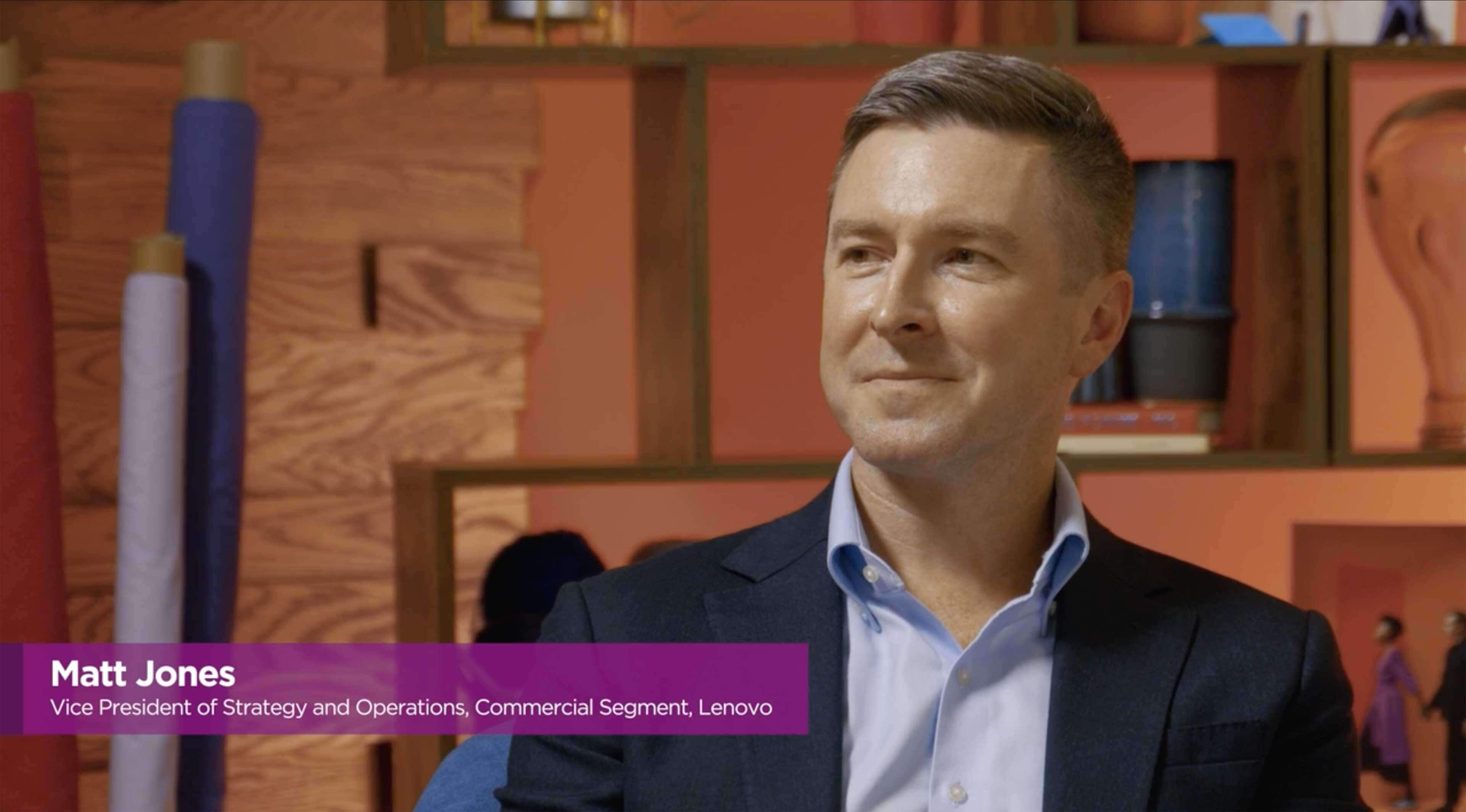
Hello and welcome to Accelerating Your AI Journey. I'm your host, Alexa Carlin, and today we're talking about supporting a circular economy, a model of production and consumption that focuses on reducing waste and maximizing the efficient use of resources. Joining me today is Matt Jones, Vice President of Strategy and Operations, Commercial Segment at Lenovo. Welcome, Matt.
Matt Jones (01:04):
Thanks, Alexa.
Alexas Carlin (01:05):
Thanks so much for being here. So tell us a little bit about yourself.
Matt Jones (01:08):
Yeah, I was reflecting on this yesterday, and I think it's been over 20 years. And I started in engineering, and didn't really know what I wanted to do, and I progressed from engineering and hardware to software, to business management. And now I really look at like, what do customers need? What value can we deliver as Lenovo? And the other side of it, like operationally, how are we executing with that delivery? So it's an interesting spot in Lenovo to be able to see everything from customers and how they can grow their business and how we can participate in that.
Alexas Carlin (01:38):
Yeah, you've got a full spectrum of different roles that you've had.
Matt Jones (01:43):
Yep.
Alexas Carlin (01:43):
Very cool. So what inspires you about helping organizations strengthen their sustainability practices?
Matt Jones (01:49):
Yeah, we're at a really interesting intersection right now. On one hand, AI is going to take people to the next level of data and analysis. On the other hand, sustainability is rooted in data analysis and understanding. We have devices. Who's using them? How are they being used? I mean, I think it's a natural intersection to figure out how do we all deliver better outcomes and do it in a way that's responsible for the planet.
Alexas Carlin (02:15):
It's an interesting intersection because at one point it's utilizing more and more power, which is not good for the environment. And then the other side, it's almost like you need AI to make it more sustainable. They're interesting. So what are you hearing from customers about sustainability?
Matt Jones (02:33):
Oh gosh. There's a lot of things that come into play with customers as they're thinking about it. And I think it really starts in some of the practices, like just how do you tackle sustainability? It used to be a box that you checked, I'm sustainable, I have a certain measurement or a certain value. And now-
Alexas Carlin (02:50):
Did this, did that, Tanya.
Matt Jones (02:50):
Yeah, check the box. And now it's really foundational in your planning and execution. It's things like, what does the finance team value? What is the procurement team value? How does your development team, who needs all of these really high-powered devices and computational skills for AI? But how are we all recognizing the value and measuring it, and understanding the policies and understanding the expectations. So sustainability is really becoming like, it's permeating organizations, and that's where this is an interesting time, because this is a journey. No one has it figured out perfectly, and we're all trying to figure this out as we move forward and figure out how to integrate AI, but also tackle and implement sustainability in the right practices to get the right results.
Alexas Carlin (03:36):
Very interesting. And so how is the drive to implement and support AI solutions increasing the need for a circular approach to resource management?
Matt Jones (03:47):
Yeah, resource management is a really interesting point because you can start with the people resources, human capital, you have all of these employees that you're trying to make more efficient and more effective. Well, how do you do that? Who are the right personas? Who are the right people, and what do they need for the jobs they're doing? And as soon as you start identifying those right people and the right things that they need to get their work done, then it becomes, well, how do you accomplish it? Sometimes you have to buy a wholesale new device because maybe they're trying to do something that no one's done before, and the capabilities don't exist.
(04:21):
Sometimes it's, how do I incrementally improve and upgrade a device? How do I take a device that, you know what, it's not going to meet the needs anymore, but maybe I can refurbish it and take it to another person and persona in my organization. Or maybe you just have to retire it. Maybe you just have to come to a conclusion. It has gone through its life cycle and it's time to move on. But it's like how do you make all of those decisions along the way? How do you get the data and the insights so that you're making the right decision? That your financial controller understands it, that your sometimes HR leader understands it, and can explain why you're taking these approaches in the organization versus just buying something brand new that's the best of the best.
Alexas Carlin (05:00):
So how do you even explain that to your team?
Matt Jones (05:02):
Gosh, I mean, that's a fantastic question. And I think to me, it always starts on, what's the outcome you want? What are you trying to achieve? And then I would say, no one's perfect today in the sense that, okay, well what's the right data to look at? How do we understand what we have today? And then sometimes it's articulating compromises, but in the end, it's taking you a finite amount of resources. How do you not do it the wrong way where you just throw a lot of money at it where you just reject all the requests, and instead go on this journey to being responsible and not only making sure that you're being responsible in the sustainability environment and for the world, and not generating a ton of e-waste and low returns.
Alexas Carlin (05:49):
So it's not just the IT department that needs to be aware of this. It's the entire organization.
Matt Jones (05:56):
And if you're a development leader, you need to understand what your engineers are doing. Like line of business decision makers need to be thinking about what are the opportunities they have in their organization, what are they doing today? And have those discussions with their end user device managers, with their IT managers, with their procurement teams, because ultimately it takes cross-functions and a large group of people to make any business successful. So you need to be thinking how you work across all of the lines to get to the right outcomes.
Alexas Carlin (06:23):
Collaboration.
Matt Jones (06:24):
Absolutely.
Alexas Carlin (06:24):
Collaboration at its finest.
Matt Jones (06:26):
Yep.
Alexas Carlin (06:26):
Right. So there was a recent survey that showed 80% of organizations view circularity as a critical or very important role for IT procurement decisions. So what makes supporting a circular economy such an attractive goal for IT teams?
Matt Jones (06:44):
Gosh, there's the word I'm looking for. What's the really interesting, perfect way which says, let's all be really good citizens of the world. Let's make sure we're not adding any extra waste. And then there's the pragmatic, practical side that especially today as you look what's happening in our industry, Windows 10 end of service next year could potentially bench over 200 million devices in the entire corporate, educational, institutional ecosystem. What are we all going to do?
(07:19):
We have to decide if there's these 200 million PCs, are we going to refurbish them? Are we going to take them out of circulation in a responsible way? Are we going to upgrade them and help one of the existing employees use them? Are we going to identify that there are new people in our organization that can benefit from a device? Windows 10 end of service next year is going to drive a huge, huge immediate refresh? I'm glad everyone's thinking about it, but we've all got to think harder and faster and figure it out.
Alexas Carlin (07:50):
Yeah, definitely. So what does Lenovo have that's going to help?
Matt Jones (07:54):
We have a couple options. One, we have something like asset recovery. It's a service that is not just about taking back your device, but doing it in a responsible, compliant way with security. We have certified refurbished services that maybe we can upgrade your device, we can get it to the next person in your organization, or there's, along the way, we have tools and capabilities to even help you understand and identify who's using the device, what does the data say, what should you be doing, helping IT managers make those decisions.
Alexas Carlin (08:23):
So what are some challenges that an IT team may face when pursuing these goals?
Matt Jones (08:28):
This is such a great question because it has several different elements that ultimately you have to pull together. Starting with data and insights. Do you know how your devices are being used? Do you know where they are in their life cycle? Are you able to make the decisions today to say that device that should be refurbished or it should be upgraded? And once you get past having those insights, it comes down to education. Because there's a lot of different teams and a lot of different elements that come into play when you're making the decision on how you deal with something during its life cycle if you're truly trying to be circular. So once you get from data to education, then you start getting into personas, and who are you trying to really work with and make sure that it all is coherent along the way.
(09:15):
And from when you look at the data to, you're working with a functional stakeholder, to knowing who the person is and the end user, and then doing that finally in a way that's compliant because regulations are really important. You can do a lot internally, but if you're not meeting the needs and expectations of the locale you're working in, you're going to have challenges. And it goes beyond even government regulations, now it's being looked at a financial level, at a social level when you get into ESG requirements. So really it's taking this journey from understanding the data all the way to, are you closing out the loop in a circular type of world, and making sure that you're compliant and executing in the right way.
Alexas Carlin (09:49):
Where can people find out all of these things that they have to be compliant with?
Matt Jones (09:54):
Sure. When you think about compliance, number one, it's dynamic, because we're on a journey. Not everyone in every single country has the same expectation. I can look at regulations in one country that would say, "20% of devices that are going to be purchased by a government have to be refurbished." I could look at another area, and you're actually making commitments to state to shareholders to say, "We want to accomplish this." Well, how are you going to measure on both sides? How are you going to make sure that a device that a government saying, "We really value this as a refurbished device." Well, okay, what does that mean? How do you get into something like a Lenovo certified opportunity to say, "This is how we measure a refurbished device. This is how you know it's something that we stand for when we refurbish it."
(10:40):
When you start looking at measurements and how you're reporting to shareholders, there are absolutely obligations there that you have to meet, but it might vary based on where you are. So it's really important to know where you're doing business, who are your stakeholders, who's setting regulations, who's setting expectations, and you have to be vigilant and pay attention along the way.
Alexas Carlin (10:58):
So if you're working with multiple global sectors, it's just different for each deck, you know?
Matt Jones (11:06):
I mean, firstly, I can tell you I've looked up regulations online. But we have Lenovo, the company also has government relations experts. We have industry experts. We sit on committees, and boards, and entities to stay up to date with regulations because we're part of our customer's success story too and their journey, and so we can't deliver them things that then they stand behind, and they're making reports out. So it's not just about how Lenovo looks at regulations, it's also how we look at it together with our customers, look at it together with where we are in the world, and just make sure we're putting the pieces together in the right way.
Alexas Carlin (11:41):
So what are some ways that Lenovo is building circularity into some of its solutions?
Matt Jones (11:46):
Sure. I mean, it starts at the device level with everything we do with how we design these devices going forward. To look at the materials, to look at the assembly, to look at the end-of-life cycle management. But then now you have to get past the device at some point. It's how do you offer things like TruScale to help customers identify it's not just about the device, it's not about the infrastructure, it's how do we take it to the next level and help them scale with what they need when they need it? It's about having services to help our customers understand the personas that they have in their organization. So as you look at Lenovo across the business group, it's how do we bring things together into one Lenovo for smarter AI, which would include the devices, the scaling of infrastructure, and the services we provide.
Alexas Carlin (12:29):
So do you have any examples of how you've seen these solutions work in action?
Matt Jones (12:33):
Yeah, and when you look at something like public sector, whether that's education, whether that's government, we all know that those budgets aren't always expanding. And recently in the last few months, I've dealt with a few examples where, whether it was working with a preschool entity to give them the right devices, but then it's not just about giving them the right devices. It's about giving them the support through the life cycle with something like our premier support or offering them asset recovery as they're trying to upgrade their infrastructure and do it in a responsible way.
(13:04):
I've worked with government entities around the world that the only way they could get the right new devices into their end user's hands was to do something like asset recovery. They needed someone to help them move the assets and do it in a responsible way. Lenovo did that, or we're working with entities in several countries at the moment on how do they navigate their procurement policies, and looking and talking to them about the products we offer and the capabilities to make sure when they're implementing it, they're using best practices from other areas.
Alexas Carlin (13:31):
So it's really not just about, oh, here are solutions or actual equipment to help you solve a problem that you have in your organization, but here is a better way to do it, to make it more sustainable.
Matt Jones (13:44):
That's the journey I'm talking.
Alexas Carlin (13:45):
Okay.
Matt Jones (13:46):
Because we are all on this journey together, and there are times we'll talk to customers and they'll give us better insights. We'll talk to another customer and share that insight. And it's not like we're trying to get proprietary details away. We're all trying to figure out how to have better performance and do it in sustainable, responsible way.
Alexas Carlin (14:02):
And why should people really care about that or focus on it? Because I feel like everyone, you have so much pressure to stay ahead of the curve. So now here's this other factor. So why should people be motivated by this?
Matt Jones (14:15):
I think the motivation becomes, they're not independent factors. Because you're going to be upgrading these devices, you're going to get the best graphics adapter, you're going to add software stacks and software layers that are going to require more performance. The only way to do this successfully without having a bone pile of old devices, or to have really confused end users that are like, "Oh, I'd love to accomplish this task, but I haven't been given the right thing." Or having a financial auditor say, "Ooh, you spent a lot of money on that device, was that really the right choice?" It just creates churn. So instead of looking at sustainability and AI and performance as independent vectors, it's really important to pull them together.
Alexas Carlin (14:58):
And create that entire circular economy almost.
Matt Jones (15:01):
Yes. Yes.
Alexas Carlin (15:03):
So what are some challenges that IT teams face in properly disposing technology that's reached the end of its life cycle? And with that, how can Lenovo help?
Matt Jones (15:14):
Sure. When you think about how you take something out of, or decommission, it's things like, how do you manage security of it? How do you make sure you're disposing of the asset in the right way, in a secure way with something like our asset recovery services? How do you sometimes even make the decision that you're going to decommission it? How do you have the right understanding and the right level of data and analytics, and how does Lenovo help you make some of those decisions in that journey?
(15:43):
Because it's going to matter based on, what is the device being used for? Who's using it? Is there anyone else that can use it? Because you don't always have to take something out of usage. You don't always have to decommission it. You might, and if you do, then it's like what's the best way to responsibly recycle it? So again, going with the whole concept of circularity and where is the life cycle, but also, who's using it, how do you deal with it to actually decommission it? If you make a decision to do that, how do you deal with e-waste? It's really the entire circular life cycle of it.
Alexas Carlin (16:15):
The answer isn't always, let me buy something new.
Matt Jones (16:18):
Correct. If the answer's always, let us buy something new, then we're going to be sitting with a giant stack of PCs. As a hardware development engineer years and years ago, I probably had 20 in a closet, and I still remember the day I had to figure out how to recycle them. That's terrible. No one wants to deal with that.
Alexas Carlin (16:32):
Right.
Matt Jones (16:32):
And as we're entering this AI era where everyone needs more performance and we're all chasing that next performance, there's a high risk of that. So we really need to be understanding, what are the needs, and what do we have in our fleet? What do we have in inventory? What do we have in our footprint? How are the needs evolving? And then let's make some smart decisions and really be purposeful about how we take it out and decommission it.
Alexas Carlin (16:54):
So if I run an organization and I have all these devices that I'm like, I need something new, I could just call up Lenovo and you'll come and say, "No, you don't need something new." Or, "Maybe you do need something," or figure out a way to-
Matt Jones (17:09):
It would be an engagement. It would be an engagement to understand and analyze, what could really happen here. What are your purposes? And I had this conversation yesterday with a new hire engineer where he's trying to do data analysis work for us. And I was getting to the point like, okay, well maybe you as the one engineer out of seven people in your department, maybe you need a new device. Maybe the rest of the team, we need to focus on how we use the devices we have and maybe improve the software stack so they're more efficient. It's having those types of discussions to really understand the personas even within an organization.
Alexas Carlin (17:41):
So it's even down to the individuals in the team.
Matt Jones (17:41):
Absolutely.
Alexas Carlin (17:46):
Or in the department.
Matt Jones (17:46):
Yep.
Alexas Carlin (17:47):
Okay. So you get a really customized, and your team helps figure that out.
Matt Jones (17:51):
Yep.
Alexas Carlin (17:52):
So one final question for you. What does smarter AI for all mean to you?
Matt Jones (17:58):
To me, it means delivering the right outcomes, leveraging AI. But that's a pretty broad statement. So when you start parsing it down it's, do you understand what you're trying to achieve? What are the tools you have? How do you responsibly get the tools to the right place they need to be? And ultimately, everything needs to be grounded in the outcomes. It can be the outcomes for your employees, the outcomes for your customers. Sometimes it's outcomes for your community that you're a part of, and we're all part of the planet.
(18:26):
So at the end of the day, smarter AI for all is advancing everything that we're doing today to make it better, more efficient, but really it's about the people, and about making sure that the people who are part of that process are better enabled. Making sure the people who are at the recipients of the outputs of that process are having a better experience. So in some ways, smarter AI for all is like people first, how do we make sure that we all understand where we're trying to get to? So ultimately, it's how you make it as efficient, effective, and responsible as possible.
Alexas Carlin (19:02):
So smarter for the people and smarter for the planet.
Matt Jones (19:04):
Absolutely.
Alexas Carlin (19:05):
Well, thank you so much for talking with us. It was a great conversation.
Matt Jones (19:08):
Thank you so much, Alexa.
Alexas Carlin (19:10):
So again, I'd like to thank my guest, Matt Jones, Vice President of Strategy and Operations, Commercial Segment at Lenovo, for stopping by and talking with us today. And thank you for watching. Visit us online to learn more about how Lenovo can support your sustainability efforts while accelerating your AI journey on the road to smarter AI for all.
Speaker 3 (19:33):
Lenovo, Lenovo.

Balancing the Promise of AI With the Need for Sustainability
Marshae Mansfield, Vice President and General Manager, Global Accounts, Lenovo
A Refreshing Approach to Technology Refreshes
Patricia Wilkey, Senior Vice President and General Manager, International Sales, Lenovo

A Cooler Approach To Powering the Future of AI
Featuring Scott Tease, Vice President and General Manager, Lenovo Infrastructure Solutions Group

Embracing AI & ROI
Simplify your AI journey and accelerate business outcomes with Lenovo’s AI Services and TruScale.

Empower Employee Experiences with AI
Learn how to empower your teams to do more with AI-powered tools and Lenovo’s Digital Workplace Solutions.

Windows 11 Migration
New episodes in May
Provide more powerful experiences and consistency with better security for all.
Coming soon

AI PC
New episodes in June
Streamline and enhance everyday tasks with smarter AI that’s personalized for each user.

Hybrid AI – AMD
New episodes in July
Find the perfect balance of hardware, software, and services that’s built to fit your architecture.
Hybrid AI – NVIDIA
New episodes in August
Achieve greater productivity, privacy, and agility with tailored AI solutions.
Contact Us

Meet Your Host,
Alexa Carlin
Alexa Carlin is an in-demand public speaker, bestselling author, top content creator for women's empowerment, and the Founder of Women Empower X. Alexa has worked with Fortune Global 500 brands to create captivating and relatable content. She has been featured on the Oprah Winfrey Network, Cheddar TV, FOX, ABC, CBS, TEDx and in Entrepreneur, Glamour Magazine, and Forbes, among others.

