
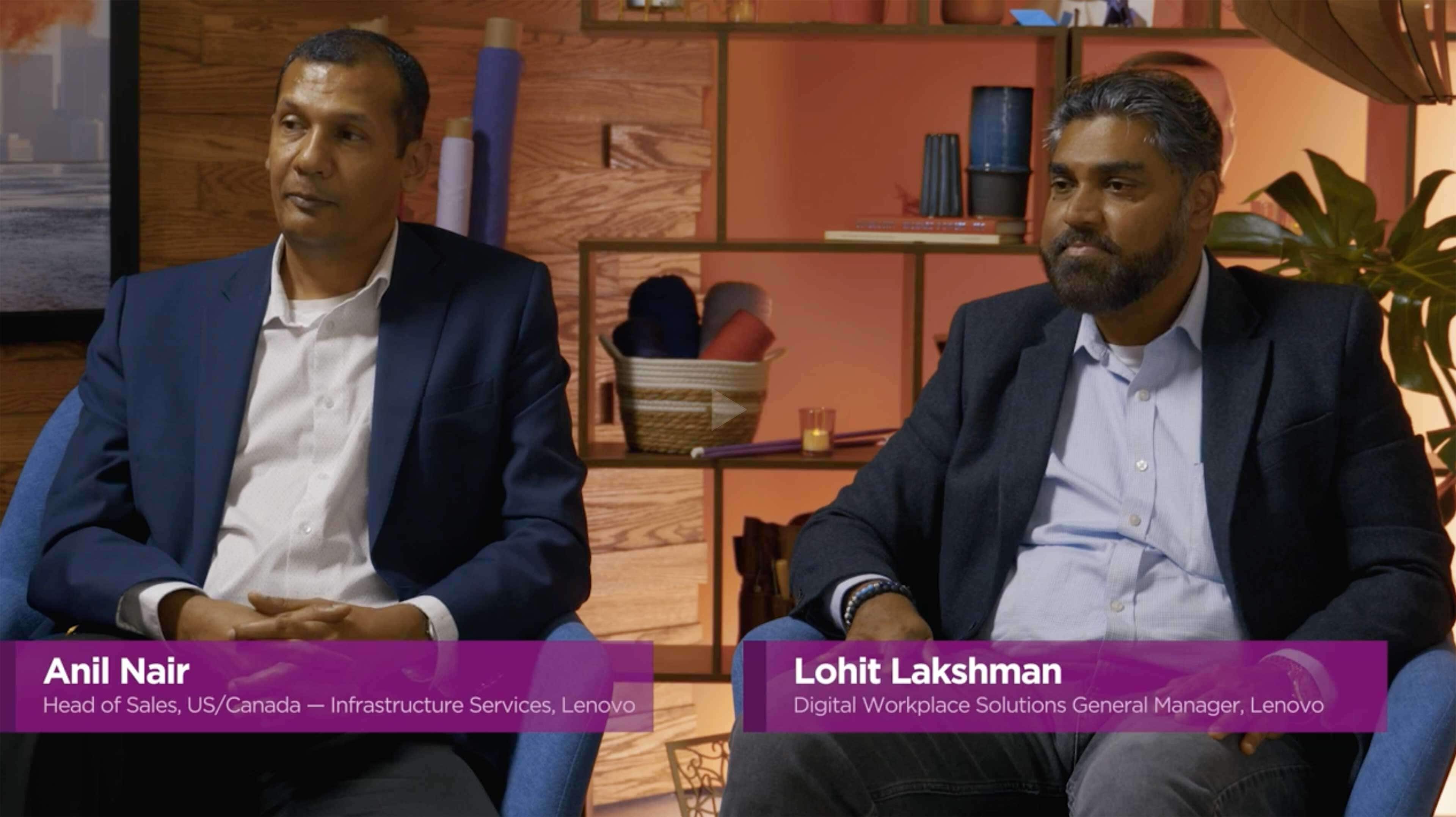
View Transcript
Alexa Carlin (00:37):
Hello and welcome to Accelerating Your AI journey. I'm your host, Alexa Carlin. AI has promised amazing advances in productivity and innovation, but what's the real situation on the ground? In this episode, we're going to talk about how businesses are overcoming barriers to incorporating AI in their workflows today. What are the opportunities? What are the considerations? Joining me today is Anil Nair, Head of Sales for Infrastructure Services in North America, and Lohit Lakshman, General Manager of Digital Workplace Solutions at Lenovo. Welcome.
Lohit Lakshman (01:17):
Thank you.
Anil Nair (01:17):
Thank you.
Alexa Carlin (01:18):
Yeah. So, just tell us a little bit about yourself. What inspires you in your current role? Anil, why don't you start?
Anil Nair (01:25):
Sure. Like you said then, my current role is essentially running sales from a DWS and a DAS perspective for North America, essentially US and Canada, with a team of around 15-odd folks spread all over the country. US and Canada is essentially what we do. What inspires me most is the people. Lenovo, with all the people around, and especially the team that I manage, they're extremely passionate about what we are doing from a services perspective. Traditionally, Lenovo is known as a hardware-only player, but today we are a complete end-to-end solution provider. So, working with these people, working with our clients is what inspires me most in my current role.
Alexa Carlin (01:25):
It's definitely exciting.
Anil Nair (02:05):
Exciting. It's exciting and more exciting stuff happening with AI coming into the picture.
Alexa Carlin (02:11):
Yes, for sure.
Lohit Lakshman (02:11):
One of the interesting things that, as Lenovo operates in 60 countries, right, we also sell products in 180 countries. So, with this many countries, you're talking about a larger workforce, more than six, 70,000 people. So, when you come into the work every day, there's always this passion which people bring in. They are committed, there is always that hunger to go back and get more. So, when you look at all of this in an impactful manner, it is completely unparalleled, right? Unparalleled to anything else. So, what you are constantly gaining and learning as an individual is also immense, and that is the passion, which always keeps me excited, again, like working with Anil or others from the rest of the organization. So, you're constantly learning. So, this is a place where you have immense opportunity for learning, but also going back and contributing to your customers. So, that is what exactly excites me at Lenovo, I would say.
Alexa Carlin (03:04):
Yeah, always able to grow.
Lohit Lakshman (03:05):
Yeah.
Alexa Carlin (03:06):
I love that. So, we know there's a lot of focus on the employee experience today. How does the technology and employee uses every day impact that experience, and would you say are expectations rising?
Anil Nair (03:21):
So, maybe I'll give it a shot, Lohit. So, we have to look at it from two perspectives, right? The pre-Covid and the post-Covid era. So, during the pre-Covid era, CXOs were always focused on reducing cost, reducing cost, reducing cost. What Covid taught us is that the employees who are the center of this entire universe is also extremely important. There was a significant war on talent, if you may, during the Covid and the post-Covid era, so the employees became very critical to the enterprises. So, what we are witnessing today is that employee experience has become front and center for most of the CIOs. I'm talking more from an IT perspective, but it's across the enterprise.
(04:03):
For CIOs specifically, the employee experience becomes front and center, second only to the reduced cost paradigm that they're chasing, right? And what we are witnessing today is that employees are getting all kinds of benefits. The hybrid work environment that we talk about is a product of the Covid era, right? Today, people have the flexibility of coming to work maybe three days a week, maybe working 100% from home.
Alexa Carlin (04:27):
Right.
Anil Nair (04:28):
It creates its own challenges from a security perspective, from a robust IT support perspective, but organizations are gearing up to deliver on all those challenges just to keep the employee happy. So, employee experience overall, when you look at it, it's becoming extremely critical because the cost of hiring is extremely high too. So, that is the reason it's become front and center for most CXO organizations. Do you agree. Lohit?
Lohit Lakshman (04:53):
Completely, completely. Just to add to what Anil mentioned, right? Today, if you look at most of the customers, we feel 50% of the employees come back and say they have issues which is happening in their workforce, and 25 to 30% of the employees come back and say, "We want to quit because we are not getting the same kind of experience"
Alexa Carlin (04:54):
Oh, wow.
Lohit Lakshman (05:13):
The CXOs are always looking at technology, and one of the other things which has completely changed drastically after Covid is also the experience, right? Enterprise customers or employees are expecting that same consumer-based experience, which is like, "Hey, we want the real technology. We want it completely fast." And with technology actually changing drastically, the change is what is expected by most of the employees in the organization. So, the CIOs and CXOs that we speak to are constantly looking at how to go back and innovate in their own organizations by adapting those particular technologies. So, that is the expectation change which is happening. And to what Anil also mentioned, the hybrid workforce, you are looking at how to go back and create productivity improvements for yourself, for your business, from your operation standpoint. So, it is a constant change, which is keeping our business in our toes, I would say.
Anil Nair (06:08):
Today, people are significantly more focused on work-life balance, and the post-Covid era, when we talk about hybrid, that is also lending itself to the work-life balances. Organizations are looking for more output from their employees, more productivity, and they're realizing that this hybrid work-from-home environment is actually delivering on that. Several organizations are happy doing that. We have heard several news in the recent past where some of the enterprises want their people to come back five days a week. That is creating friction in the market where people are saying, "You know what? If I have to go back to office five days a week, I might as well go and find another job." Right? So, that's the overall employee experience that we're talking about. This has become paramount in today's post-Covid world.
Alexa Carlin (06:49):
Yeah. You're seeing these employees have different priorities now that they've gotten a taste of working from home.
Anil Nair (06:53):
Exactly.
Alexa Carlin (06:54):
Definitely
Lohit Lakshman (06:54):
Keeping them motivated on a day-to-day basis is the constant ask which the CXOs have, how to go back and keep them motivated. At the same time, not impact the productivity with the operations. Last but not least, the cost is always there, right? Adapting new technologies means you're going to have cost impacts. How do you go back and balance all of this together and keep it far more relevant and relative to the operations? That is what exactly the needs are, I would say.
Alexa Carlin (07:21):
So, a lot of AI features are being incorporated into operating systems and applications. So, what does a business need to fully leverage these different tools like Microsoft Copilot?
Lohit Lakshman (07:34):
So, it's interesting, right? We talk about Microsoft Copilot and all this stuff. There are two parts of it. Typically, from an organization standpoint, the first and foremost is you have to go back and have the right kind of infrastructure where you're able to go back and get the benefits of these particular platforms. When you talk about infrastructure, you're talking about both hardware and the software. How do you go back and get that? The second most important is, how do you go back and get this integrated to all the different systems? At least until all of the systems don't talk to each other, you're not going to go back and get the benefit of it.
Alexa Carlin (08:07):
Right.
Lohit Lakshman (08:07):
There are other subtle things which also have to be kept in mind, right? Training. Technology comes with a lot of expectations of your employees and your organization to adapt. So, there has to be that investment on training, empowering your employees how to go back and better get the value of the investment that your organization is making. And rest of the other things, right, like in compliance, be it data management, be it continuous improvements, are the other things which go hand in hand together. with that, I would say.
Anil Nair (08:37):
I would probably only add a couple more things. One is around the data part of it, right? Take Copilot or any other AI tool, is only as effective and as useful as the data that resides underneath it. So, there is a significant amount of drive today in organizations to use the data in a much more effective way, right? So, that is one part of it that will drive a successful AI implementation, whether it's Copilot or something else. Next one is, the pace at which technology is changing, even within Copilot, the version releases that they're making is so huge that unless you are adapting to that newer technologies, your infrastructure, like Lohit mentioned, is not scaling up to deliver on that new level of data that is coming. The new capabilities of the technologies that are coming to your ecosystem, you'll not be able to take advantage of Copilot or any other AI tool.
Alexa Carlin (09:28):
You kind of touched on my next question for you, which was basically how can organizations future-proof their investments in AI-powered solutions? So, is there anything you want to add on to that?
Lohit Lakshman (09:42):
Most of the organizations are not very clear about their objectives, right? You have to go back and understand that AI can cut across the organization's industries, verticals, everywhere. But most important aspect is you have to define tangible benefits that you want to achieve in a very, very specific amount of time, because implementing any of the solution takes time. It also takes effort and money. So, you have to really understand how to go back and identify those objectives, which are going to get you the maximum benefit. Once you have that, it becomes easier for you to go back and throw this particular changes in your organization faster.
Anil Nair (10:18):
The one thing that I'll add is the agility, right? I read a metric where they were talking about the large language models, the LLMs that were coming out. Beginning of 2023, they were averaging probably three to four LLMs a month. Today, 2024, they're averaging 25 to 30 LLMs a month. So, that is the pace at which this technology is moving. Unless you are able to scale your operation to take advantage of those things, you cannot really future-proof. That is one.
(10:46):
Second, when CIOs go and ask for money from the CFOs, the biggest driver for them is what is the ROI on this money that I'm spending on AI, right? Till probably 10 years ago, every organization, every CIO was focused on digital transformation, right? Everybody is talking about that. How can you help me digitally transform my enterprise? With AI coming in, two things that are happening. One is, you don't want to be viewed as a corporation, as an enterprise who is not embracing AI. And that can go against you, that can go against the CEO when he's going out and doing his earnings call, right? So, you don't want to be perceived as somebody who's a laggard from an AI perspective.
(11:22):
Second, CFOs want to know what is the ROI because the investor community is asking them, "Okay, you're investing X, Y, and Z dollars on AI. What have you got in return?" Right? So, that's another aspect that the CEOs are focused on, the CFOs are focused on. CIOs are struggling to deliver on that aspect of ROI, ROI from an AI perspective, right? So, future-proofing is a very, it has a multifold dimension to it. There are so many moving parts, especially given the newness of the technology and the power that AI is bringing to the table, right? So, there are a lot of moving parts over this. It's all probably a jungle out there. Things have to fall in place, and we are all struggling to learn at the same pace.
Lohit Lakshman (12:05):
Just to add to what Anil mentioned, right, as Lenovo, one of the key things that we do is we help the customers understand the potential of optimization that you get from AI. We look at POCs, we go back and even have the AI discovery workshops where, as a company, we can come back and help our customers identify this scope and the benefits the AI platform can give. The solutions are immense, right, across, you'll find different vendors, different products available. We can come back and cater to the specific solution which your organization can benefit, and that's where Lenovo looks at it.
Alexa Carlin (12:42):
I think both of you said two very important things. One, it's unique to every single organization, and there's not a one-size-fits-all. And two is that we're all learning at the same time, and I think a lot of leaders or even new people in IT or in different organizations where they're having this pressure to adopt different AI solutions, and they're like, "I don't even know where to start." But if we come with the perspective that we're all in this together and learning and growing, I think more people would be more motivated to learn.
Anil Nair (13:19):
Correct. In fact, that is one of the, you touched on a very important point. Where do I start, how do I start, right? In fact, Lohit's team is working on a care solution called the Care of One Solution, which is a service delivery platform that Lenovo is developing, which is a very easy start package, and this is really creating a significant amount of traction in the market today from a Lenovo services perspective. When we talk to our customers, they think this is an excellent tool for them to address that same question that the CIOs are asking their IT directors, how do I start, where do I start? What is the fastest way to get to ROI? Going to the CFO question, what is the ROI on this, right? We can probably touch upon Care of One if there's an opportunity, but that is certainly one of the ways that CIOs are embracing AI, GenAI in their workplaces as well.
Alexa Carlin (14:10):
Definitely. You want to share a little bit about Care?
Lohit Lakshman (14:12):
So essentially, Care of One is a platform through which we are actually providing outcomes for our customers. So essentially, what we've done is we have created a particular platform through which we can deliver our digital workplace services solutions and also the DAS solutions. So, the core, any of this particular solutions that we have for customers are constantly looking at value, right? Can I go back and have cost savings? Can I go back and reduce the effort and improve productivity for employees? All of this is happening through technology. So, the Care of One technology actually enables our organization to get those particular benefits. In the back end, you're looking at incorporating all of the solutions and interventions, which we talked about, in a holistic manner. So, the customers are not having to go back and build it out. They're able to go back and consume it as a service culture.
Alexa Carlin (14:59):
Okay. So, that kind of leads into this question where, what are some organizational benefits of as-a-service approaches to procurement?
Anil Nair (15:09):
Yeah. See, as-a-service is not a new concept, right? What we have been seeing even over the last 20, 30 years is organizations want to focus on what is core to their business versus non-core, right? If you're a bank, you want to be focusing on your customers and creating those deposits and the investment opportunities for your customers. So, for your clients. You don't want to be focused on patching a machine or working on an IT support ticket, right? That is non-core for your business. It's not revenue generating, right? So, two concepts. Either you focus on revenue or you focus on cost, right? Organizations typically want to focus on revenue. So, when it comes to as-a-service, that's exactly the paradigm that we are addressing, which is telling them, "You focus on your core business, and what is non-core to you, give it to us because this is what we do for a living at Lenovo."
(15:59):
This is what we do for a living. As a service, we provide, device as a service, for example, or any other as-a-service product that we talk about infrastructure as a service. What we say is we take out your pain point, we own the thing end-to-end, and deliver on the measures and the outcomes. So, the client is there getting all the benefits of the best of breed technology because Lenovo can invest in it because that is our business. CEOs love that, CFOs love that. Why? Because I'm taking cost out of their equation so that they have the opportunity to focus on more on the revenue growth aspects of it.
Lohit Lakshman (16:31):
And most importantly, just to add to what Anil also mentioned, right? As a technology company, we're constantly investing in some of this new innovations, which the market is going, right? And there is all of this learnings that we have. For any organization or a customer or ecosystem, for them to get all of this understanding, takes a lot of time. The economics of scale, which you get as a service, is tremendous. At the same time, because you're taking it as a service, you can actually go back and very, very specifically define what your requirements are. So, you don't have to worry about all the investment which goes in to incorporate some of this technology into your ecosystem. Those are kind of inherited by your provider. So later, we'll actually invest constantly in some of the solutions, right? It could be latest technology, which is AI PC. Hey, getting all of that built in, so if you're trying to go back and help technology get to you in a which far more simpler manner, in a faster manner.
Alexa Carlin (17:26):
So, let's talk about how AI is helping IT teams keep employees productive as they leverage these new AI-powered solutions.
Anil Nair (17:36):
Let's take a use case like Lohit mentioned, right? IT support. Even in the recent past, there are situations where people have to call somebody, an 800 number or whatever within the organizations. They're waiting for resolution for hours and days together, right? With a solution like Care of One that we spoke about a little while ago, what we are saying is that you have a database and you can actually solve these problems on your own. You're self-serving, right? So, we have a situation where we are saying, "Okay, you know what? I don't really need to be on the call for half an hour talking to a person. I don't need to be waiting for that guy to go find out what the solution is coming and fixing it after a day, two days, or three days of creating downtime. But I have access to a database which is coming from Care of One."
(18:21):
It's saying, "Okay, what, did you try X, Y or Z?" And boom, you have probably the solution, solved the problem in maybe 15 minutes, 20 minutes versus the three days. Directly impacts the productivity. So, yes, there is the initial cost of investment from a Care of One perspective, but it has already delivered the dividends of that investment by keeping you productive, unproductive only for 15 minutes versus three days. So, that is very powerful from a CIO perspective. That is very powerful from CIOs, the users, the business users, the power users, even the CEO for example, who probably had to wait for three days to first thing to be up and losing business in the process.
Lohit Lakshman (18:57):
It's also self-learning, right? When you look at some of these GenAI solutions, you have to constantly learn. But also at the same time, you have to make it very, very specific. Users are coming back and expecting specific solutions. What Alexa does versus what Anil does is completely different. We have different roles in the organization, so each of them is expecting specific customized solutions, and that's what is the flexibility which GenAI and Care of One is able to provide to both to employees and the customers.
Alexa Carlin (19:26):
So, you touched on a little bit on how AI is helping solve day-to-day challenges with employees. Can you speak to how does a unified approach to endpoint management help with cybersecurity?
Anil Nair (19:41):
When you look at unified endpoint management, right, or UEM as it referred to, if you compare and contrast it to what was in place before that, right, before that, it was multiple people doing multiple stuff. There was no uniformity across an enterprise in terms of what are the do's and don'ts. With UEM, what has happened is that there's one central philosophy that is governing the entire aspect of the device management, right? So, you have one, you say multifactor authentication, everybody has to go through the same thing. Take a password renewal. Everybody has to renew it every 90 days.
(20:15):
So now, it's a policy. Those guidelines, those policies are set at the central level, at the universal level, and everybody in the enterprise follows that. Becomes easy to implement. Patching, for example, there are so many vulnerabilities that are there in the marketplace today. Every day, there's a new virus that is being deployed. You have somebody in the centralized team from a UEM perspective, looking at what is happening in the market space and introducing a patch that goes in and places itself on every device that you have with enterprise. Earlier, it was kind of self-driven. I'll do it over the weekend, kind of a thing. Today, that is not the case. Today, we are forcing everybody to do it.
Lohit Lakshman (20:52):
And automated in that particular sense. You don't want go back and make it manual. You want to make it automatic. Sorry, I cut across.
Anil Nair (20:59):
No, no, no, exactly. That's a very important point. So now, you are not in control,, the enterprise controlling your devices and that's the reason UEM is extremely important, and hence how it ties into the security aspects of it, because the enterprise is now owning. The onus and security is on the enterprise, not at the individual level. It's not for me to say, "You know what? Here is a series, let me load it and do an antivirus." But it is a new antivirus, the enterprise is pushing it down onto your laptop, you're automatically secure, right? So, that is the reason UEM has become extremely in the post-Covid world, because look at the complications. We never had in the hybrid workforce earlier.
Alexa Carlin (21:34):
Right, because it doesn't matter if you're in the office or at home.
Anil Nair (21:36):
It doesn't matter. If you're connected to the internet, you are hooked onto the enterprise, you will basically need to. If you have to log in, you have to have this in place before that, right? Second is this concept of BYOD, where can, enterprise is saying very flexible. Going back to the employee experience, your first question is that, "I want to use a Mac today, or I want to use a Lenovo machine today. I want to use some other machine." Doesn't matter. You can bring your own device. But the philosophy, the guideline, the compliance that we need to ensure exists in the enterprise will be the same, right? So, that is also leading itself to the security aspect. It's extremely secure in today's world with UEM.
Lohit Lakshman (22:14):
And one more important thing, interesting use case, which as Anil was speaking just came across to me, was data. You look at all of this environments where you have. You want to go back and identify an incident which might potentially be happening, right? Assuming an employee's hits a particular world vulnerability, and you record that particular stuff. You should be able to go back and see who are the similar machines or devices which are going to get impacted, because most of them will have the same pattern. So, if I have the kind of data, I'm able to go back and predict that this vulnerability is going to impact 40% of my workforce. I'm able to go back and take actions on that immediately.
Alexa Carlin (22:58):
[inaudible 00:22:58].
Lohit Lakshman (22:58):
Absolutely. So, I don't have to wait for something to happen in my ecosystem. I'm able to take action based on one particular incident, and I'm able to go back and say, "What is the cost of that incident?" And be able to rectify that immediately. So, that kind of data insights is only possible with UEM solutions and bringing this digital workplace solutions together. You cannot do cyber resiliency isolation with UEM and Service Desk. You have to all tie it together and be able to manage it. You have different groups managing it, you have to go through the process. Instead, you bring them all together, you get a very, very faster response to any kind of situation that you have in your ecosystem mode.
Alexa Carlin (23:36):
And I would imagine it helps with collaboration also, right? So, we're all on the same page, yeah. Growing at the same rate. So, a good IT support experience can be critical to maintaining not only employee productivity, but morale as well. So, how is Lenovo leveraging AI to help organizations deliver in that area?
Anil Nair (24:02):
From a morale perspective, it's multifold, right? One is the access to the tools and the technologies that you have in the market, right? Like I said, alluded to earlier, training is a very big component. Today, instead of it being a classroom training, it's all self-learning, right?
Alexa Carlin (24:02):
Right.
Anil Nair (24:18):
Having the ability to access all those tools, technologies, and the learning curriculum to help you upskill yourself is a very big plus point for employees today. And there are organizations today who are actually buying learning material from the training organizations and deploying them free, of course, for their employees as part of their overall employee experience, as part of their overall employee satisfaction thing, right?
Alexa Carlin (24:40):
A lot of times you see that even on the HR page, where that's a benefit to working for that company.
Anil Nair (24:46):
Exactly, exactly. There are a lot of companies who advertise the fact that here are the 10 programs that we have from a benefits' perspective that you will get if you join Lenovo as a company, right? Even in Lenovo, we have access to significant amount of training material, which may be technology specific, which are even beyond technology. It could be general lifestyle specific trainings that are available to generally deliver on that work-life balance that we spoke about earlier. So, when you look at morale, again, it goes back to employee experience. That is what is the cornerstone of today's enterprises, which is keeping their employees happy because they realize that the cost of retention is not as high as the cost of hiring. So, you're better off retaining your people that you have because we've already invested in them, right?
(25:28):
To keep them in place, these are the perks. This is one of the benefits that comes in place and automatically delivers on the employee morale as well. I'm sure there are several other things that we can talk about over here, but AI is enabling that because AI can actually tell you today, that given your profile and given your work environment, this is the scope of work that you're involved in, here are probably the five trainings that you should be engaged in because this is what is going to help you upskill yourself and get to this new project that Lenovo is potentially working on. So, it's a very close loop mechanism that we're talking about over here where one thing leads to the other and it helps you. It guides you automatically. There's no HR or no manager who needs to sit with you and advise you on the do's and don'ts.
Alexa Carlin (26:12):
Right.
Anil Nair (26:13):
AI is doing that for you today.
Alexa Carlin (26:15):
So, one final question, and I'm going to ask both of you, if you want to start. What does smarter AI for all mean to you?
Anil Nair (26:22):
Well, I think it's a very smart tagline to begin with. But I think more than a tagline, it is something that the company believes it. It is more than a tagline because, at Lenovo, when we talk about AI and smarter AI, they actually walk the talk, right? We were at TechWorld, what is it, two weeks ago or probably three weeks ago in Seattle, and we had sessions over there where people were coming and talking. These are people who actually went through a lot of health related issues. I don't want to get into that aspect of it, but it was Lenovo's programs that help them. When we talk about smarter AI for all, it is inclusivity, right? We are not leaving any group, any community, any aspect of life on this planet behind. What we are saying is that everybody gets an equal chance at embracing AI, right, and utilizing it for their own benefit.
(27:14):
It could be upskilling yourself, it could be learning a new skill. It could be some work-life balance issue that you're addressing. It could be a health benefit that you're talking about. It could be Care of One solution that you're developing for within Lenovo and for your customers. It could be anything and everything, but it truly is more than a tagline because Lenovo actually believes in that it should be able to touch everybody. And inclusivity is probably the one word that comes to mind when you talk about smarter AI for all.
Lohit Lakshman (27:42):
I don't think he has left anything else for me right now. But the only way I would summarize it is, it's technology which can be easily consumed by anybody and everybody, and the ease at which you can actually go back and implement a solution, at the same time simplify the problems and overall improve the experience. That is what exactly I go back and refer to as modern AI for all, I would say.
Alexa Carlin (27:43):
It's almost like a way of light.
Lohit Lakshman (28:10):
Absolutely. It has to become a second nature for everybody. So, that's how it has to.
Anil Nair (28:13):
That's certainly where we are headed to. Yeah.
Alexa Carlin (28:16):
Well, thank you so much. This was a great conversation and I really enjoyed learning from the both of you.
Anil Nair (28:21):
Thank you.
Lohit Lakshman (28:21):
Thank you.
Anil Nair (28:21):
Thanks for your time.
Alexa Carlin (28:23):
So, again, I'd like to thank my guests, Anil Nair and Lohit Lakshman from Lenovo for stopping by and talking with us today. And thank you for watching. Visit us online to learn more about how Lenovo can help you with accelerating your AI journey, on the road to smarter AI for all.
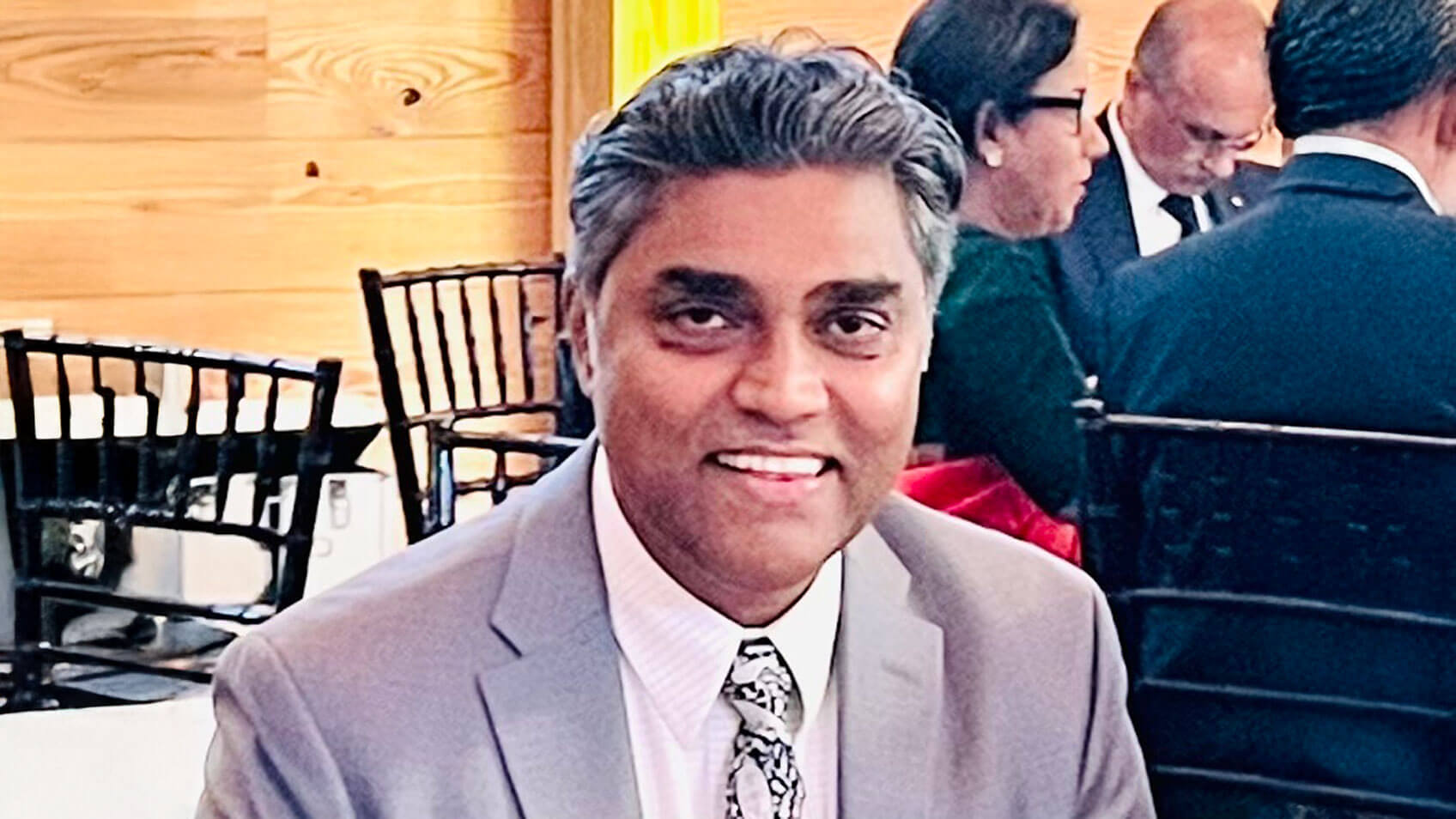
Anil Nair
Head of Sales, US/Canada, Infrastructure Services, Lenovo
Anil Nair is an IT Services industry professional and a customer-focused business manager with 25+ years of experience in consultative selling, solution development, and global delivery. He is skilled in business and IT consulting and adept at IT strategies, especially as they relate to achieving competitive advantage in business.

Lohit Lakshman
Digital Workplace Solutions General Manager, Lenovo
Lohit Lakshman is responsible for strategy ideation impacting business and enabling the long-term strategic objectives of “always on” business. He focuses on solving business problems through digital innovation with the ability to bring impactful solutions to each client’s unique requirements by adopting end-to-end strategic execution models.
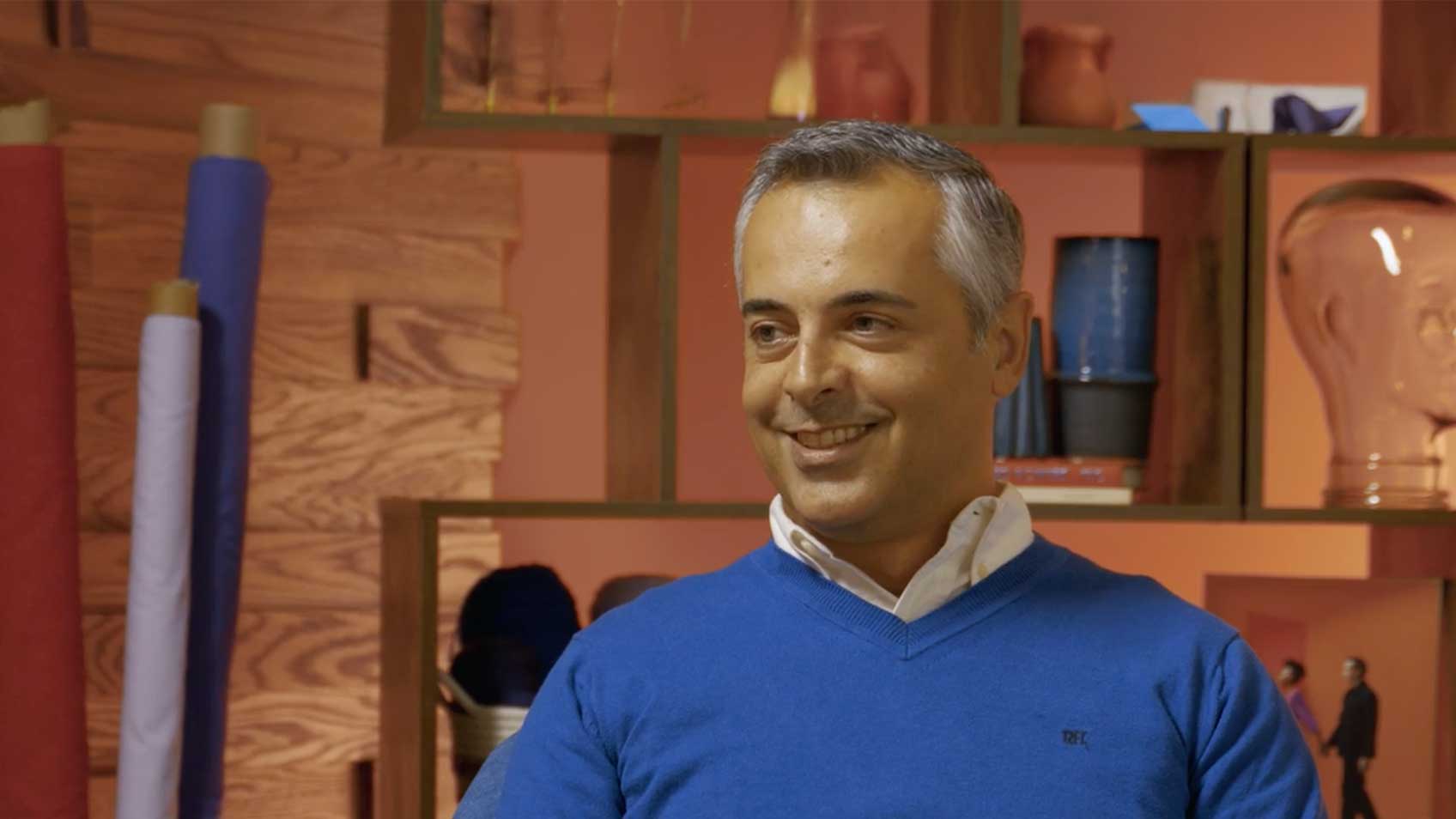
Driving ROI With AI
Tiago Da Costa Silva, Strategy and Planning Director, Digital Workplace Solutions, Lenovo

Navigating Sustainability in the AI Era
Find out how you can leverage AI and still meet your sustainability goals.

Embracing AI & ROI
Simplify your AI journey and accelerate business outcomes with Lenovo’s AI Services and TruScale.
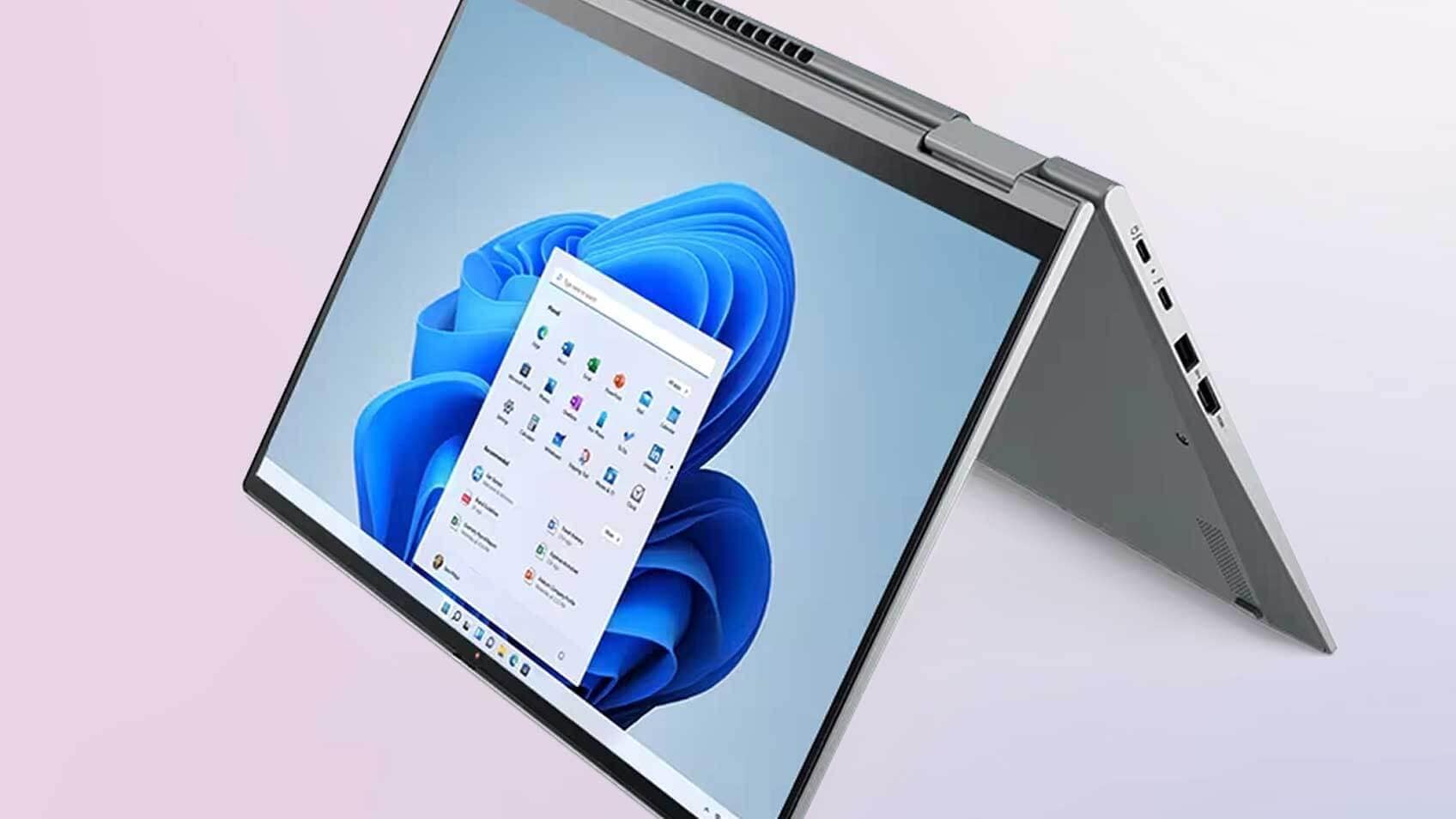
Windows 11 Migration
New episodes in May
Provide more powerful experiences and consistency with better security for all.
Coming soon

AI PC
New episodes in June
Streamline and enhance everyday tasks with smarter AI that’s personalized for each user.

Hybrid AI – AMD
New episodes in July
Find the perfect balance of hardware, software, and services that’s built to fit your architecture.
Hybrid AI – NVIDIA
New episodes in August
Achieve greater productivity, privacy, and agility with tailored AI solutions.
Contact Us

Meet Your Host,
Alexa Carlin
Alexa Carlin is an in-demand public speaker, bestselling author, top content creator for women's empowerment, and the Founder of Women Empower X. Alexa has worked with Fortune Global 500 brands to create captivating and relatable content. She has been featured on the Oprah Winfrey Network, Cheddar TV, FOX, ABC, CBS, TEDx and in Entrepreneur, Glamour Magazine, and Forbes, among others.

