
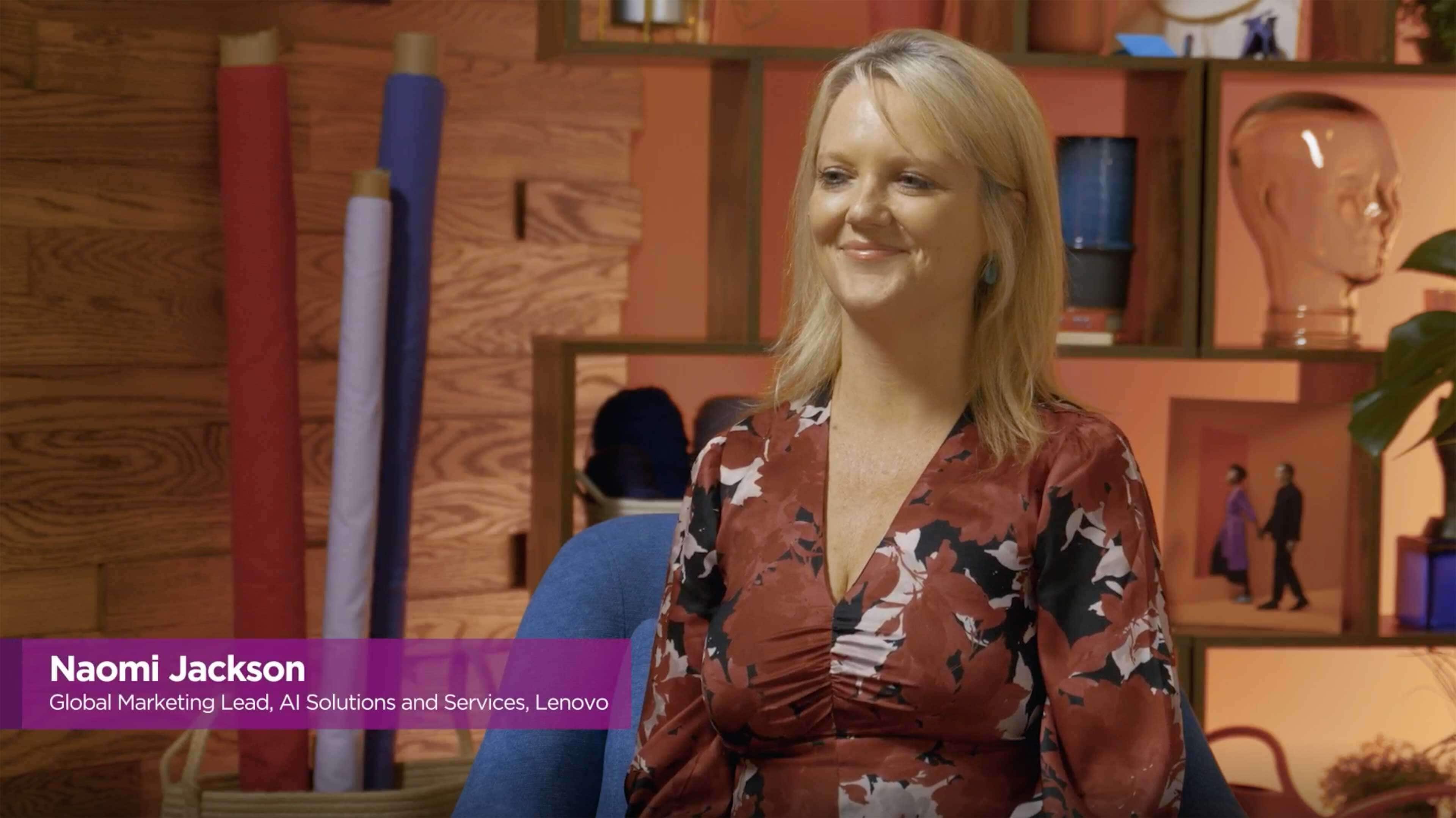
View Transcript
Alexa Carlin (00:36):
Hello, and welcome to Accelerating Your AI Journey. I'm your host, Alexa Carlin, and today we're talking about hybrid AI. What is it? What makes it different from early incarnations of AI, and how are businesses accelerating its use? Joining me today is Naomi Jackson, global marketing lead, AI solutions and services at Lenovo. Welcome, Naomi.
Naomi Jackson (01:04):
Hey, Alexa. It's lovely to be here.
Alexa Carlin (01:05):
So tell us a little bit about yourself.
Naomi Jackson (01:08):
Well, I'm actually pretty new to Lenovo, actually just joined this year. But my role is leading marketing for our AI services and solutions globally. So basically it's my job to help publicize and let the market know about all the fantastic services and solutions that we have around AI for our customers globally.
Alexa Carlin (01:30):
It was a big job.
Naomi Jackson (01:31):
It is a big job, but very exciting.
Alexa Carlin (01:33):
Very exciting.
Naomi Jackson (01:34):
Yeah.
Alexa Carlin (01:34):
So what inspires you most about working with hybrid technologies?
Naomi Jackson (01:39):
So generally I have always been inspired by emerging technologies because they're always at the cusp of what's coming next. And what's always really enjoyable to me, aside from the fact that I have a very short attention span, I'm always looking for something new, is just to see that transition from where it's a concept or a technology that nobody knows about, doesn't quite understand, is probably a little bit fearful about to it actually fundamentally changing how they work, how they live, how they play.
Alexa Carlin (02:12):
Right. It helps understand it when you apply it to your everyday life.
Naomi Jackson (02:17):
Indeed, for sure.
Alexa Carlin (02:18):
So let's just take it back a little bit. Can you explain what exactly hybrid AI is?
Naomi Jackson (02:23):
Sure. So if you think about what the purpose of artificial intelligence is, it's basically to help us as humans do more and be more, right? It's giving us additional intelligence. And when you get helpful intelligence that it's going to really accelerate outcomes for you in the workplace in particular, you want to be able to pull on some intelligence that might reside in the cloud. You might need some information from the enterprise and some data internally within your organization. And then there is probably information in your emails and your own personal devices, but you also want to be able to pull on, have synthesized and served up to you as intelligence that you can actually use to do your job better and faster.
(03:10):
And so for Lenovo, we look at hybrid AI as really that pockets the cloud from the personal devices and laptops, your mobile phones through the enterprise systems that you might have in your organization and to the public AI in the cloud.
Alexa Carlin (03:30):
So you have this triangle almost?
Naomi Jackson (03:33):
Yeah, and I almost think of it as again, the pocket to the cloud really gives you that mental image of wherever your information or your data resides, you're able to pull on that to produce relevant intelligence that you can use to do more and be more with AI.
Alexa Carlin (03:54):
So from anywhere in the world?
Naomi Jackson (03:55):
Exactly. Yeah.
Alexa Carlin (03:56):
Okay, interesting. Very cool. So in your role, you spend a lot of time tracking changing customer needs. What are some of the emerging trends and behaviors you're starting to see?
Naomi Jackson (04:08):
Yeah, I mean, I think definitely we are seeing people become more comfortable with AI and it becoming a real sort of assistant to them. Of course, for years now we've had our series, but it's really becoming common vernacular, a copilot for example, which again, looking back 12, 18 months ago was not very common taxonomy that people understood. And they're seeing how, particularly within the work environment, it can help them do more and to almost move them from a late page to 50% along the task that they're trying to do.
(04:46):
And so for sure there is that directional trend of people becoming more comfortable with AI, but also the extension of that is the agents and assistants that are becoming members of your team at work and actually taking some of the tasks that are not the highest value, you probably don't want to do them that much yourself, like structure a well-thought-out email or capture all the outputs from a meeting and the key actions. But even things like we're seeing some of our customers looking at using it to do things like be a legal assistant and help process some of those more transactional activities like reviewing NDAs. They're pretty sort of... Yeah.
(05:36):
And so you can imagine that especially the high value that a legal assistant brings or that a lawyer brings, being able to have some of those mundane tasks to repeatable tasks being carried out by an agent or an AI assistant, really does, not only make their function much more productive and efficient but actually builds the satisfaction, I guess, of the employees actually doing those roles. So those are two of the key areas. But I guess, the flip side is that we've talked about AI for a long time and a lot of our customers and generally in the market hearing still the challenge of, "Okay, how do I first of all choose the right use case for AI?" So there's a little bit of confusion, there's so much possibility, how do you possibly choose what's right for your organization?
(06:31):
And then second to that is we also hear of a lot of organizations that have trouble actually moving from, "Okay, I've got this great idea, I've maybe done a bit of a proof of concept. How do I translate that into something that I can scale across my organization and drive business value from?"
(06:49):
And so we're very focused particularly on helping customers break those barriers to return on investment. Because at this stage, we're now almost two years since generative AI really changed everything. And so, organizations and leaders are really wanting to be able to show some value from those experiments and from those initial forays with generative AI.
Alexa Carlin (07:15):
And I love how you said it's almost like a member of your team.
Naomi Jackson (07:20):
Right.
Alexa Carlin (07:20):
Because I think people are nervous it's going to take jobs, but it's almost like early on when you go into business, you learned, "Delegate, delegate, delegate." So you could focus on your most important tasks where you need that brainpower.
Naomi Jackson (07:35):
Exactly.
Alexa Carlin (07:35):
So now it's not necessarily where you have to hire more people. You hire those people for a higher level of work and then delegate to different AI solutions.
Naomi Jackson (07:48):
Yeah. And just the processing power of AI, I mean, it can just do so much more, so much faster in so many ways. And if we're able to really intelligently take advantage of that capacity, we can do so much more as human. And I think it's just, again, it does depend on the use case, and you want to very much be thoughtful about the teams that this can really drive the most value from because you want to get some of those proofs of the possibilities of AI to help with the almost change transformation that's required in most organizations to embrace AI. But that being said, there really is tremendous potential for us to all do more and be more with AI. Really exciting.
Alexa Carlin (08:41):
And it allows you to focus on the things you do enjoy.
Naomi Jackson (08:44):
Exactly.
Alexa Carlin (08:45):
All those mundane tasks. I mean, every job has them.
Naomi Jackson (08:47):
Yes.
Alexa Carlin (08:48):
Just offload them to-
Naomi Jackson (08:49):
And I am looking for the time where we only have to work three or four days a week.
Alexa Carlin (08:50):
Oh, yeah.
Naomi Jackson (08:54):
We can put the rest off to AI.
Alexa Carlin (08:56):
Yeah, well, it could be possible with accelerating the AI journey.
Naomi Jackson (09:01):
That's right. That's the entire... Yeah.
Alexa Carlin (09:03):
All right, so we talked a lot about different things that you're seeing, right? Emerging trends, but one of the trends that we hear is moving the AI closer to the data. What does that mean and why does it matter?
Naomi Jackson (09:16):
So it goes back a little bit to what I was talking about before with the hybrid AI environment that spans across your personal AI, your enterprise AI and your public AI. And being able to synthesize, filter and basically proactively bring to your employees the intelligence that resides across all of those domains. And the reality is that most intelligence or a lot of intelligence is founded on data. Now, the challenge that many organizations face is that they don't necessarily have their data right for AI. So there is that hurdle and that obstacle, and that is another challenge that organizations face in starting to drive value from AI.
(10:06):
But that's really what we're talking about is with all of this tremendous data and information that you have across those three environments, that you're able to pull those together, you're able to access those in a way that drives relevant intelligence for what you're trying to do.
Alexa Carlin (10:24):
Yeah, relevant is a key word.
Naomi Jackson (10:25):
That's right. Yeah.
Alexa Carlin (10:26):
Definitely. Because sometimes we get overwhelmed, there's so much data process to look through, like, "Where do I even start?"
Naomi Jackson (10:32):
Exactly. Yeah. For sure. And that's why many organizations find that it's not enough. In fact, I would say all organizations find that it's not enough to lean only on public cloud, for example. Even as individuals, we can't entirely depend on public AI models and public cloud for our information for a number of reasons. The fidelity of the information, the quality of the information, security, all of those sorts of things. But also there is just so much information in all of our organizational systems, in our enterprise data and our enterprise AI as well as I mentioned before, even some on our own laptops and mobile phones, et cetera. So it's not going to be the full picture or as powerful if we are not pulling from the full hybrid AI stack and all of the hybrid AI domains.
Alexa Carlin (11:30):
That actually leads perfectly into my next question I had for you. So what are some use cases where an organization would require bringing private AI platforms into the scope of what they're doing?
Naomi Jackson (11:43):
So one of the examples is the legal use case that I shared with you earlier. I mean, you can't make decisions about an NDA, for example, without pulling in some of the corporate policies and enterprise guardrails. But really any enterprise use case probably requires private AI just because of the security, but also all of that information that resides within your organization. And for me personally, a great example is how I use generative AI on a daily basis, which is a solution that we have that enables us to basically generate content 90% faster.
(12:24):
We have some inputs based on key messaging, and then our tuned language model for marketing helps to produce relevant materials about our products and solutions. And so, it gets us maybe 50 or 60% of the way there. You still need the human element to fine tune the narrative and to make sure it's the right messaging, et cetera. But that aggregation of all of the product information and the previous enterprise information that we fed into that language model does get us at least 50, 60% of the way there.
Alexa Carlin (13:04):
Wow. That's something internally that you used to get-
Naomi Jackson (13:06):
Exactly. Yeah.
Alexa Carlin (13:06):
Wow.
Naomi Jackson (13:07):
Yeah. So my team is using that. So it's again, an example of something that I couldn't do with the public cloud or public AI model that would not be... I'd be lucky to get 5% value out of that. So being able to really lean on the internal enterprise data and our own internal intelligence is a great example of where that sort of enterprise AI or private AI model is critical. We can pull on external resources and information from the public cloud and public AI models, but it's very finely tuned and also more secure, for example, because we've tuned it for our own organization.
Alexa Carlin (13:54):
When you first started using this, were you just like, "Wow, I can't even believe the output"?
Naomi Jackson (13:58):
Oh, it's great. Yeah. And I'm a fairly early adopter of generative AI, but it also is very stark to me the difference of, say using a ChatGPT and asking it to produce a brochure for me based on some inputs versus doing it with a model that's trained and that is optimized for our enterprise environment for our team.
Alexa Carlin (14:26):
Wow. I realized that it was groundbreaking when my mom and dad started using it. And my mom uses it to write some Facebook posts.
Naomi Jackson (14:37):
[inaudible 00:14:37].
Alexa Carlin (14:37):
And my dad used it to write a song for her for their anniversary.
Naomi Jackson (14:44):
See.
Alexa Carlin (14:46):
So many different use cases, not just business.
Naomi Jackson (14:49):
Yeah. And again, that's where I personally get so much pride out of being in tech is because you do see it actually. I mean, it's small thing, but these are the things that actually again, do help to make our lives better as humans. And so whilst we always need to, again, have a level of responsibility and accountability and need the necessary transparency and guardrails, et cetera around AI, and we should never completely rely on it, it's fabulous that your dad's able to write a song.
Alexa Carlin (15:23):
Yeah.
Naomi Jackson (15:23):
Or 50% of the way there on a song for your mom, right? That's priceless. Yeah.
Alexa Carlin (15:28):
So tell us a little bit about Lenovo Hybrid AI Advantage and how Lenovo is bringing value to customers and partners like Nvidia.
Naomi Jackson (15:39):
Okay, so this I'm really excited to share about. So essentially, Lenovo is uniquely positioned, as I mentioned before, because from our Motorola phones, our PCs, right through to public AI, we're able to meet customers wherever they're at. And this full stack, this complete full stack AI portfolio is really... enables us to have the building blocks of the Lenovo AI library, which is part of what we've announced with the Advantage. And so this library is a series of use case accelerators that have essentially industrialized some AI use cases from a technology perspective. Again, powered by the infrastructure and devices we have, data, the models and the services that we have and that we bring together with partners like Nvidia to help customers deploy AI across various use cases much faster.
(16:40):
And so the accelerators typically allow customers to deploy about 50% faster because they're more focused on taking that technology backbone or that technology set of building blocks and tailoring it with their own enterprise data, et cetera, to customize for their organization versus having to start from the basics and actually build the technology foundations for those intelligent agents.
(17:07):
So that relevant intelligence is what is driving outcomes faster. And by partnering with Nvidia and our other innovation ecosystem partners, we're able to do that, bring those use cases, et cetera, in whatever environment the customer chooses. So we are very intentional about whether they're an Nvidia partner or otherwise, being able to optimize and accelerate those outcomes for customers in their chosen environments.
Alexa Carlin (17:39):
And better outcomes.
Naomi Jackson (17:40):
And better outcomes. Exactly. Yeah.
Alexa Carlin (17:42):
So what are some ways that, outside of this AI library that Lenovo is helping organizations accelerate outcomes from hybrid AI?
Naomi Jackson (17:52):
I mean, I think it's really key to, again, be able to help customers where they're at and align to the outcomes they're trying to achieve. We can help them with definition of those outcomes. So certainly the services, one of our key services is around helping from an AI perspective customers to define those outcomes aligned to their business objectives. But really the other power that we have is not just the use cases in the library, but essentially the end-to-end portfolio that we have that enables those use cases, the technology backbone, if you like. And then as I mentioned before, there's really nobody else who has the scale from our Motorola phones through to our public AI. And the fact that we're able to operate across all of those domains, help organizations to navigate how to drive relevant intelligence from those domains, that's how we bring the most value to customers.
Alexa Carlin (19:02):
Yeah. Right. It's almost like Lenovo has become an AI company.
Naomi Jackson (19:06):
Absolutely, yes.
Alexa Carlin (19:08):
Because people, maybe they don't think about that right from the get-go, that's your job.
Naomi Jackson (19:19):
That's my job.
Alexa Carlin (19:20):
You're doing a good job.
Naomi Jackson (19:20):
Thank you. And I think that that's the beautiful and the opportunity is that Lenovo is well-recognized as number one PC manufacturer in the world, and with our tremendous infrastructure heritage. So across hardware, we have proven ourselves to be a trusted partner to customers and being able to build on that with the services and software and basically our solutions-led approach. We're really able to help customers build on the relationships that we already have with them if they've already got our devices and infrastructure. But also, again, particularly with things like the Lenovo AI library, we're able to help them shortcut or accelerate their AI journey. So I'm more than happy for us to be known as the AI company going forward, for sure.
Alexa Carlin (20:11):
Yeah. I mean, it's great to be on the cusp of everything that's going on, but not just reacting to it, but helping create it.
Naomi Jackson (20:19):
Exactly. And again, I think we're all very passionate about helping customers achieve outcomes from AI. It's not purely a technology for technology's sake. It's very much about how does it help you operate more efficiently? How does it help you drive more productivity and satisfaction amongst your employees? How does it help you innovate to grow? And I think that's the thing that's often underestimated is when you're freed up to do more and less of the grunt work, you actually unleash the creativity and the innovation of your people. And that, I think is something that we're all looking for. We always want to be able to do new things and innovate. But again, it comes back to that personal satisfaction and that capacity to do more, that really is the tremendous opportunity of AI.
Alexa Carlin (21:11):
Yeah. It's not about replacing jobs, it's about enhancing the human potential.
Naomi Jackson (21:15):
Yeah, we talk about augmentation in that respect. Yeah. And it's often not so much... There is changing of tasks. And again, some of those tasks better off than AI takes because we don't like doing them anyway, or they're so highly repetitive that it makes sense that AI does that with its processing power so that we can do the things that make us uniquely human, be creative, be innovative, et cetera.
Alexa Carlin (21:42):
Right. And all innovation stems from creativity.
Naomi Jackson (21:45):
Exactly.
Alexa Carlin (21:46):
We want to help that, right?
Naomi Jackson (21:47):
That's right. Yeah.
Alexa Carlin (21:49):
So what guidance do you have for leaders to realize more value from hybrid AI?
Naomi Jackson (21:56):
I think it touches on what I mentioned before, be focused and I know that's easier said than done, but it is, I think the historical approach with technology to want to transform at large scale. And it didn't really work as effectively as we would've hoped from when everyone was talking digital transformation. I think the learnings that we've had with our customers, and even internally because we do... Before we release any of these use case accelerators into the market, we prove them out, we test them internally, and obviously across 182 countries, that's a highly scaled organization.
(22:42):
So yeah, what we've learned is identify those use cases, drive some value, scale some of those use cases that might seem quite specific or quite distilled or refined, but ultimately those are the ones because you're clear on the outcome you're trying to achieve, that's where you're best positioned to actually show return on investment. So my guidance would be focus on some of the use cases rather than necessarily trying to do large-scale transformation from the get-go.
Alexa Carlin (23:15):
And that's inspiring, right? Like, "How can I help this one little part or sector of my business, make it more efficient or make it better?" And then from there, then you do another part another, and all of a sudden you're running a very efficient organization.
Naomi Jackson (23:30):
That's right. And we can all be agents of that change. I mean, it doesn't need to be the C-suite who comes up with some of those use cases or some of those ideas. So again, the beauty of generative AI is that we all have that power and that capacity to think of ways that we can do more with AI in our respective workflows or within our functions and work environments.
Alexa Carlin (23:53):
I love that. To be an agent of change where anyone can.
Naomi Jackson (23:57):
Yeah.
Alexa Carlin (23:57):
So one last question I have for you. What does smarter AI for all mean to you?
Naomi Jackson (24:04):
This is why I love generative AI. Such a geek. I sound like a geek. I'm really not that technical. But no, again, I love it because this is where we are putting AI into the hands of your mom, your dad, and making it actually useful for them. They're actually getting some value and they can again, contribute. They can be part of whatever change or whatever value that they're driving, whether it's writing a song or whether it is, "Hey, actually that response to that prompt isn't right. Let me tell the model, 'No, that's not appropriate for whatever reason. Or that's wrong for whatever reason.'" So that's really smarter AI for all when there is that accessibility and we can all, not only derive benefits from AI, but we can influence and drive more value from it by contributing and participating.
Alexa Carlin (25:02):
Thank you so much, Naomi.
Naomi Jackson (25:03):
It's been a pleasure. Thank you.
Alexa Carlin (25:04):
Great talking to you. So again, I'd like to thank my guest, Naomi Jackson, global marketing lead, AI solutions and services at Lenovo for stopping by and talking with us today. And thank you for watching. Visit us online to learn more about how Lenovo can help you accelerate your AI journey on the road to smarter AI for all.

Naomi Jackson
Global Marketing Lead, AI Solutions & Services, Lenovo
Naomi Jackson leads marketing of Lenovo's AI Solutions and Services globally. In this role, she drives product marketing direction and positioning strategy for Lenovo's AI and technical solutions. Naomi specializes in working with C-suite leaders and technologists to help organizations and people understand AI and get value from investments in data, cloud, and security.

3 Tips for Scaling Responsible AI in a Global Enterprise
Rick Kreuser, AI Center of Excellence Tech Lead, Lenovo

Future-Proofing Your AI
Gerald Longoria, Director, Business Unit Executive, Hybrid Cloud Services, Lenovo

Navigating Sustainability in the AI Era
Find out how you can leverage AI and still meet your sustainability goals.

Empower Employee Experiences With AI
Learn how to empower your teams to do more with AI-powered tools and Lenovo’s Digital Workplace Solutions.

Windows 11 Migration
New episodes in May
Provide more powerful experiences and consistency with better security for all.
Coming soon

AI PC
New episodes in June
Streamline and enhance everyday tasks with smarter AI that’s personalized for each user.

Hybrid AI – AMD
New episodes in July
Find the perfect balance of hardware, software, and services that’s built to fit your architecture.
Hybrid AI – NVIDIA
New episodes in August
Achieve greater productivity, privacy, and agility with tailored AI solutions.
Contact Us

Meet Your Host,
Alexa Carlin
Alexa Carlin is an in-demand public speaker, bestselling author, top content creator for women's empowerment, and the Founder of Women Empower X. Alexa has worked with Fortune Global 500 brands to create captivating and relatable content. She has been featured on the Oprah Winfrey Network, Cheddar TV, FOX, ABC, CBS, TEDx and in Entrepreneur, Glamour Magazine, and Forbes, among others.

